Category Archives: Biocultural Evolution

Issues and Ideas about Our Intertwined Biological and Cultural Inheritance, Environments, and Identities

Image, Narrative, Symbol, and the Enigma of Arrival

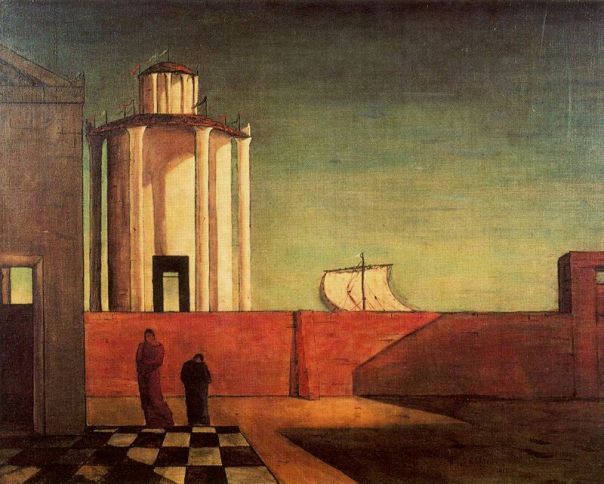
The Enigma of Arrival and the Afternon (Giorgio de Chirico, 1912)

Arrival is ambiguous. Both as a word with multiple diametrically opposed, context-dependent meanings … and also as an embodied social experience. Even if we humans did not have the capacity of grammatical, meaning-generative language to communicate with one another, our socially intensive, long lives entail that we would experience arrival in a much more variable array of manifestations, which would become thoroughly entangled in more complex memories, than do our closest ape relatives or would have our Miocene ape ancestors.

But we do have language. We construct stories and webs of symbols out of the underlying symbolic structure of grammatical, meaning-generative language(s), which we begin to learn already in our first months of life. And the word “arrival” (and its close translations in other natural languages) is an example of how referential symbols, even when they have many different meanings that could easily be confused in everyday social situations, focus our thoughts. Meaningful symbols direct our attention and often help us sustain it, as we continue to think and act. The symbols we use in everyday life don’t always have clear referents. When we begin tell a story about arrival, different listeners may start to imagine or assume how the narrative will unfold. It might be imagined as a story about arriving someplace new, about growth, challenge, discovery. Or as a story about return. It might be a routine arrival, part of a regular cycle of departure and return. Or it might be truly unusual, a once-in-a-lifetime experience. Using the efficient symbolism of the same word, “arrival,” for all of these different patterns, each instance of which would inevitably be constituted by unique circumstances, our imaginations exploit this arbitrary common thread tying together the successive experience of different arrivals with the experience of remembering or telling about arrivals. And thus, symbolic language helps us remember, helps us to imagine the similarity and difference between self and other, helps us to connect disparate experiences that might be separated by decades. Helps us to connect our own experiences to fictional events or abstract notions related to arrival: beginning, ending, the cyclical and recurring, the temporally directional and changing, the known and unknown, the forgotten and remembered.

I would suggest that the use of words–whether initially constituted by learned hand-gesture or vocalization sequences–would have been favored by natural selection, for pointing toward concrete states of affairs quite immediately relevant for bodily homeostasis and that of kin on an hourly or daily basis (monitoring for predators and dealing with hunger, thirst, thermoregulatory balance, exhaustion, caring for dependent juvenile offspring). Symbolic pointing, as Michael Tomasello (2008) has so eloquently and rigorously argued, allows the individual to influence the attention of others, and with eye-contact and constant monitoring, spoken discourse allows dyads or larger groups to manage joint attention. And this would be particularly advantageous for survival in a more open vegetation pattern in the terrestrial habitat that our ardipithecine and australopithecine ancestors had adapted to between ca. 7 – 3 million years ago in East Africa. Especially when food and water resources were diverse, heterotrophic, and often difficult to find and extract. Simple noun utterances referring to people, things, and actions could be combined with bodily gestures and gaze direction to negotiate small-group movement and activity in the hominin omnivorous, terrestrial, extractive niche that was then evolving. But arbitrary word symbols–taken by learned convention to point toward something quite concrete, like a particular kind of fruit, seed, or animal prey–can easily acquire a more general, ambiguous, or abstract referent in a socially intense environment, as long as the speakers maintain the word-symbol usage. The initial evolutionary limitation for cultural increase in lexicon size in late Pliocene or Pleistocene hominin groups would have been on the anatomical, time, energetic, and social cost of sending or understanding a message. But there would have been persistent selective pressure favoring more efficient, rapid, varied utterances and more effective understanding and memory, simply because being able to learn and point to more particular kinds of situations in the near environment would enhance survival and reproductive success. And because such simple linguistic pointing to nearby, recently witnessed or soon-hoped-for states of affairs in the environment would reinforce mutual monitoring and cooperation, the resulting increase in sustained social interaction and joint attention would support learning of words for general categories of food, pronouns, and basic but environmentally compassing events, like sunrise and sundown … or social states of affairs, like arrival.

And with learning of such symbols pointing to general phenomena that sit in a higher nested hierarchical relationship to specific events or things (“arrival,” “animals,” “plants,” “food,” “stone,” “baby,” “adult”), our hominin ancestors would have been able to focus their imaginations and memories on stories or scenarios in which self is compared with other. This, even before natural selection would have favored further cognitive processing power to learn many additional symbolic grammatical items, so that such imagined or remembered stories could be uttered and shared. Whether this evolutionary process took place relatively earlier or later, slightly more quickly or more slowly, it would have been a gradual one. But the evolution of our linguistic capacities would have co-occurred with the construction of our niche as a conspicuously socially intense one. There would have been a positive, reinforcing feedback in natural selection, favoring the capacity to learn and to send more–and more varied–symbolic messages, and these with more varied referents … in turn, favoring the networks of sustained social relationships in which these symbols and their variable referents would have been invented, learned, and exploited. And in this context favoring participation in larger social networks with more sustained, interdependent social relationships, the embodied and logical focusing effect of arbitrary symbols, which sustain an individual’s attention in imagination on patterns of shared experience with others, would have supported the evolutionary emergence of “theory of mind” and empathy. A new person I’ve never met before has just arrived in the valley. How would I feel if I were the stranger arriving, hungry, tired and thirsty, in a new group?

But more general, abstract words–with their multiple, context-dependent referents, however learned and sustained through interaction in multiple, complex, intense, constantly negotiated, interdependent social relationships–are ambiguous. Language helps us to adapt socially to a really complex niche. We can share information about parts of the environment beyond what we can immediately see, hear, or smell … And we can plan jointly with others, cooperating to exploit resources in those out-of-immediate-reach parts of the environment. The arbitrary nature of words as polysemous symbols has a more surprising logical effect. In focusing the imagination, abstract words like “arrival” can logically support or evoke thoughts that constitute human consciousness, in fundamentally contrasting existence with non-existence, being with nothingness, life with death as the negation of life. And this would in turn produce the individual’s consciousness of family and society as constituting the universe, existence of the world. This is fundamental to understanding why human culture is more than just learning and information sharing. Culture is also the process of consciousness logically leading us to construct narratives and images of the social relationships on which we depend as integrally tied to cosmological order. And these stories and images move us.

REFERENCES

Tomasello, M. (2008). Origins of Human Communication. Cambridge, MA, USA: MIT Press.

Do Plants Think?

Arabidopsis thaliana

A recent article on plant chemical behavior has received press attention because the researchers have shown that plant cells can effectively carry out basic arithmetic calculations. The article–by Scialdone et al., in press in the journal e-Life–describes experimental results confirming what researchers have theoretically expected, based on mathematical calculations about biochemical behavior. Basically, it appears that after a few hundred millions of years of terrestrial plant evolution, genes in the cells of leaves produce different proteins that keep track of how much starch photosynthesis has produced in each cell during the day AND how long it’s recently been dark at night over the past few days. Starch catabolism is key for the plant at night, since energy from the starch fuels the organism’s physiological maintenance and growth. And the pace of starch degradation and mobilization appears to be critical. Plants appear to have the capacity to use available starch during the nighttime, so that starch runs out almost exactly at dawn. Regardless of how plants achieve this, the authors note, “[i]n the model plant Arabidopsis thaliana this phenomenon is essential for productivity: mutants with defects in either the accumulation or the degradation of starch have reduced productivity and exhibit symptoms of starvation.” Scialdone et al. (in press) combine formal mathematical models with laboratory experiments in which they control Arabidopsis plants’ day-night cycles. The result is that plants are able to update circadian clock information about changes in night-time duration, while using up starch at a rate so that–as long as the laboratory scientists don’t drastically change the duration of nightime from day to day–their energy source runs out right around dawn. The neat chemical trick is that some proteins are sensitive to the amount of starch, carrying out reactions in the cells at a rate directly proportional to starch granule availability, day and night; other proteins are sensitive to the duration of daylight and nighttime. The enzymes that directly facilitate starch degradation interact with circadian rhythm enzymes, so that starch degredation enzyme concentration is influenced by current starch quantity, but also limited by the circadian-rhythm enzymes, whose concentrations relate to time to dawn.

This is an analog way of carrying out a continuously updated division problem: starch is consumed at a rate that equals current starch availability level divided by how much time is expected to be left until dawn. Consumption = Starch Amount ÷ Time Left Till Dawn.

The authors state, “Our analysis here has underlined the utility of analog chemical kinetics in performing arithmetic computations in biology. Importantly, we have for the first time provided a concrete example of a biological system where such a computation is of fundamental importance.” It is very likely the case that activity in networks of neurons are maintained and modulated by similar analog biochemical systems. Thus, many cognition researchers would agree that the way we store information in our brains about what’s happened in the past, so that it can modify bodily responses in the future, involves chemical feedback systems that are shaped by–and thus represent–environmental stimulus patterns from the recent past (see Chemero 2009). In fact, chemical concentrations of different kinds of biomolecules–from neurotransmitters to hormones to a range of other cellular enzymes and DNA transcription factors–can mutually influence each other in our bodies, thus storing information that is distributed not just in our central nervous system but throughout our bodies. No one would argue that plants are intentionally carrying out division problems. And in fact, we’d be much worse than plants if we had to measure our own food-levels consciously and constantly, and also measure information about how long that food will have to last in the near future, so that we could slowly but constantly sip away at that food until we can reasonably expect to get more. Natural selection on DNA over a huge time period has favored a robust chemical system in plants, adapting their metabolic cycle to day-night rhythms in the environment. But the demonstration of how chemical concentration feedback systems can store and apply information in Arabidopsis plants gives us a tantalizing hint about the more complex web of cellularly, physiologically, and anatomically structured biochemical feedback systems underlying embodied human thought and consciousness. Thus, the difference between human consciousness and plant starch utilization is not entirely night-and-day.

REFERENCES

Chemero, A. (2009). Radical embodied cognitive science. Cambridge, Mass.: MIT Press.

Scialdone, A., Mugford, S. T., Feike, D., Skeffington, A., Borrill, P., Graf, A., … Howard, M. (2013). Arabidopsis plants perform arithmetic division to prevent starvation at night. eLife, 2. doi:10.7554/eLife.00669

What Evolves in Evolution?

Even before Darwin, it should be remembered, scientists contemplated the notion that different kinds of organisms evolve–that is, have evolved in the past and conceivably continue to evolve. And that the evolution of living organisms has to do with adaptation over many generations of reproduction.

The evidence for adaptation through differential reproduction over the generations–driven by differential fitness of the variety of heritable traits in a population … of bacteria, oak trees, people …–is unambiguous. Yet, the implications for how we think about life remain challenging. In my experience, this is particularly the case on two levels. First, biology students have difficulty–especially initially–staying focused on evolution as a gradual process of complex change in differential reproduction over thousands generations. Second, instructors–especially those who have limited background in biology, say, in teaching an introductory anthropology course–have difficulty, more often than one would expect, in combining clear presentation with effective exercises and discussions that would better help students really own and use accurate knowledge of long-term evolutionary processes and outcomes. The evolutionary process is indeed complex, because what changes (again, over many many generations) is simultaneously:

  • random mutation rarely but persistently altering how bits of DNA function, sometimes increasing the fitness of a given bit in the environment, sometimes decreasing it
  • the characteristics that those more fit bits of DNA build or influence, as they chemically shape phenotypic “vehicles” for their own survival and reproduction (Dawkins 1982a, 1982b)
  • variation in adjoining bits of “neutrally fit” DNA that have succeeded in hanging on for the ride while accumulating harmless mutations
  • the sustained or accumulated, often ecologically structuring impact of DNA’s chemical, usually complex and indirect influence on those phenotypic vehicles that have already been favored by previous generations of natural selection … with the critical, pervasive effect that DNA indirectly but systemically, cumulatively changes its environment over long time-frames (Odling-Smee et al. 2003)
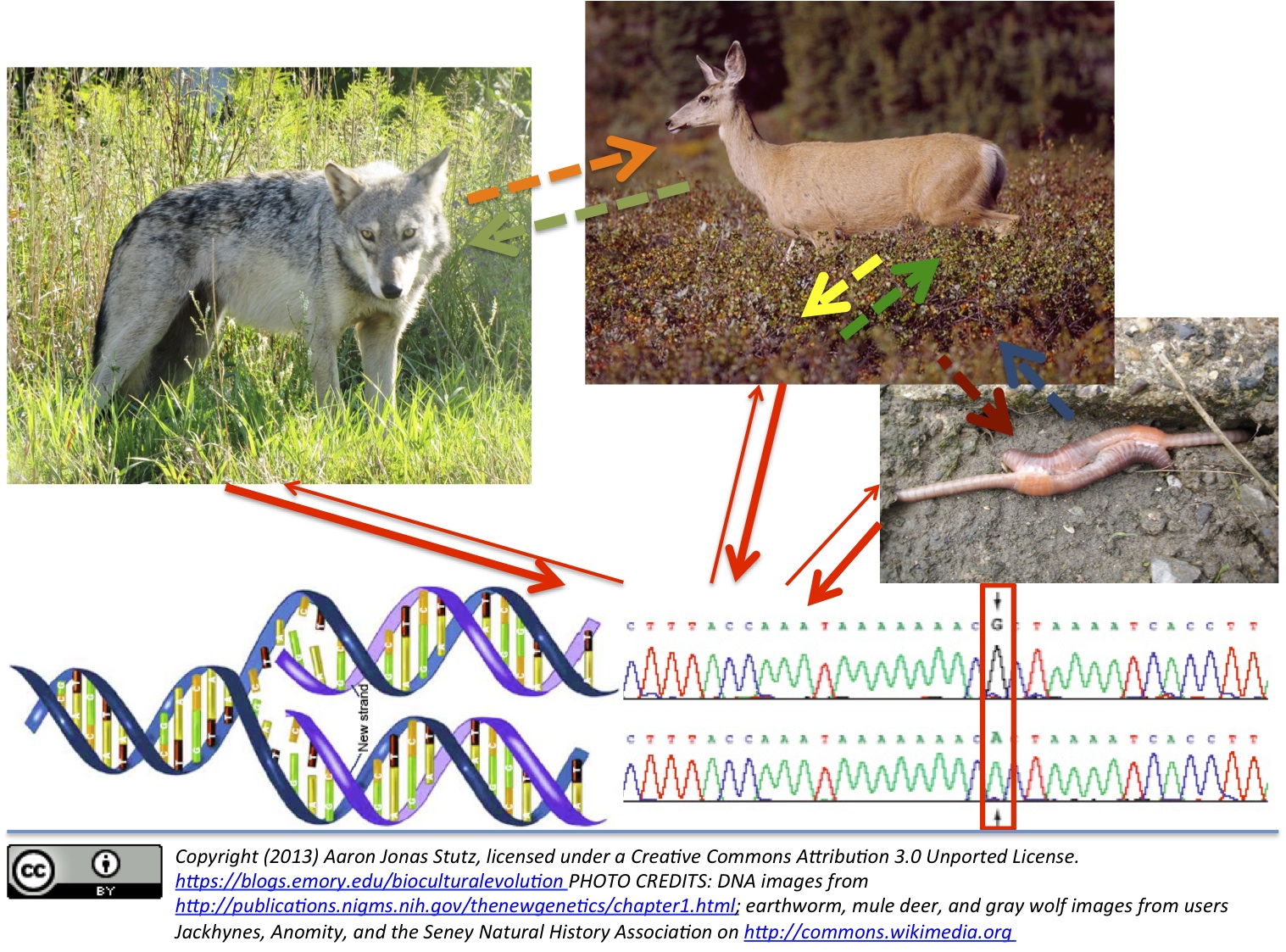
Populations of DNA shape phenotypic "vehicles" that are better or worse fit to their environments. Occasional random mutations in DNA replication produce variations among DNA strands in the vehicles (anatomical, physiological, biochemical, behavioral) that they build or influence. Those DNA strands producing better-fit vehicles will be more likely to survive and replicate. The long-term interesting result about life on Earth is that DNA populations shape complex environments, even as those cumulatively-forming environments structure which DNA variants subsequently survive and replicate. Due to random biochemical copying errors (a.k.a. mutation), DNA maintains a constant potential to change the environment, no matter how resilient an ecological balance has emerged in the environment, through food-web and habitat modifications. Thus, constantly DNA stands in a non-nested systemic hierarchical relationship to its environment.
Populations of DNA shape phenotypic “vehicles” that are better or worse fit to their environments. Occasional random mutations in DNA replication produce variations among DNA strands in the vehicles (anatomical, physiological, biochemical, behavioral) that they build or influence. Those DNA strands producing better-fit vehicles will be more likely to survive and replicate. The long-term interesting result about life on Earth is that DNA populations shape complex environments, even as those cumulatively-forming environments structure which DNA variants subsequently survive and replicate. Due to random biochemical copying errors (a.k.a. mutation), DNA maintains a constant potential to change the environment, no matter how resilient an ecological balance has emerged in the environment, through food-web and habitat modifications. Thus, constantly DNA stands in a non-nested systemic hierarchical relationship to its environment.

The intricacy of this process may best be conceptualized with a series of abstract notions, like populations and allele frequency change. But at the intro level, just trying to get your head around these thoughts can deaden what provokes curiosity about evolution: birth, maturation, aggression, cooperation, sex, and death in nature. BTW, I had to go with the language “more fit bits” once it popped into my head, since it sounds somewhat disgusting, even a bit obscene. BUT … but hopefully you’ll remember the bigger point about why students find it especially difficult to conceptualize the evolutionary process.

Now note that the complexity of evolution is not irreducible. It is reducible to how DNA chemically functions, impacting its environment, and in turn influencing which DNA-chain variants survive and copy themselves more effectively in that environment. While scientific knowledge always philosophically involves doubt and acknowledgment that there are unknown phenomena in the universe, science is also an active stance for seeking explanations for observable phenomena that involve natural causes or processes. (This perspective is, of course, contra what proponents of “intelligent design” try to sell us on, where it is claimed or hoped that God comes in, every once in a while–allowing us to witness biochemical systems or anatomical structures, at least in some organisms, that exhibit such complexity so as to defy the very physics or chemistry according to which those organisms’ genes are naturally supposed to have evolved or operate. Such claims very simply amount to hoping–because of an a priori belief in divine intervention in nature–that repeatable, independently verifiable observations do indeed record phenomena that scientific inquiry will never ever be able to explain. Among other profound philosophical problems with Intelligent Design–the perspective of which takes a seemingly tactical step away from the Biblical literalist point of departure of so-called “Creation Science”–is this: it is really arbitrary which poorly understood observable phenomenon is left open to scientific curiosity and investigation and which is asserted to be so complex that we can decide here and now that said complexity is evidence of an active divine hand in nature. And this makes Intelligent Design not only a willfully ignorant stance, but also very corruptible, highly susceptible to arbitrary appeals to phony scientific authority.)

Getting back to what evolves in evolution, I would emphasize four absolutely key take-homes from the above brief summary of the evolutionary process:

  1. Evolution does indeed happen in populations of organisms whenever there is change in DNA diversity from one generation to the next … and thus, evolution is not really that interesting in the short-term … but it is happening.
  2. IT’S FEEDBACK, PEOPLE: evolution is understood to occur without irreducible complexity, exactly BECAUSE DNA impacts–and thus changes–its own environment, even as random mutation in this theoretically infinitely long biopolymer causes variation in DNA’s very function … including complex interactions among its own chemical products in and around cells … In other words, DNA regulates its own chemical self-copying function–albeit with occasional copying errors (a.k.a. random mutations)–at the same time that it influences other chemical products in its own environment, in which the chemical replication proceeds … so that sometimes DNA has a strong non-nested hierarchical filtering effect on the environment, although most of the time, the environment has a stronger non-nested hierarchical filtering effect on replicating DNA.
  3. Evolution is interesting in the long-term–that is, over thousands or millions of years–because that’s when all the drama of birth, aggression, cooperation, sex and death emerges. The challenge is that it comes from the complex, occasionally shifting non-nested hierarchical feedback between DNA and its environment, and that leads to much more than anthropomorphically titillating drama … evolution has produced spectacular ecological phenomena that have given the planet Earth a richly dynamic but resilient biosphere–one that’s survived all forms of physical change on the planetary level (plate tectonics and volcanic eruption) and solar system level (oscillations in the Earth’s orbit and variations in solar radiation intensity) over a couple of billions of years.
  4. It’s worth being interested in points 1. and 2. BECAUSE if you’re interested in 3., then the first two points help you answer a lot of questions and even ask some new, really smart ones.

This is more than just my two cents, as a college instructor in biological anthropology, for why deeper understanding of evolution is worth the effort and how students might begin to answer AND ask better questions about why life works the way it does. As virtually all biologists would emphasize, everyone agrees that evolution in DNA allele frequencies goes on all the time–and in all forms of reproducing populations, from bacteria to trees to whales. But not everyone agrees on the reasons why long-term evolution is most interesting. In scientific discussion and research there arises all kinds of logically derived, yet diverging views about how to analyze the relationship between boring, short-term allele-frequency changes over a few generations and complex, interesting patterns, which may range from DNA function to organismal development to food webs to major adaptive radiations of species … and even to mass extinctions. Among the best known scientific debates about emergent evolutionary process unfolded in the 1970’s and 1980’s: Does speciation, extinction, and adaptation follow a gradual or a punctuated equilibrium proces (Eldredge and Gould 1972; Gingerich 1984, 1985; Gould and Eldredge 1977)? Are common phenotypic traits in populations best assumed to be adaptations shaped by natural selection or structural connectors or place-holders that really have nothing to do with adaptation (Gould and Lewontin 1979; Mayr 1983)? Have most fixed alleles in populations evolved by random drift, despite being selectively neutral (that is, having no influence whatsoever on vehicles that might favor or disfavor replication in the prevailing environment) (Kimura 1983)? Is the branching history of species best reconstructed by phenetic or cladistic analyses of their traits (Gingerich 1985; Stuessy 1987)? Should species be considered individuals (Vrba 1984; Vrba and Eldredge 1984; Vrba and Gould 1986) or should we really mainly focus on the “long reach of the (selfish) gene” (Dawkins 1982b)? No one said that science is easy, but it should be done right, and these theoretical and technical debates were part of the scientific process of trying to get the answer right: asking the right questions, using the right models, making the right measurements, carrying out the right analyses, so that observations could be replicated by other scientists and the research questions, methods, and conclusions all logically connected. Many of these debates have been eclipsed by the flood of data that has come over the past 25 years or so. Now, thanks to increasing computational power and DNA sequencing technologies, biological researchers have begun developing methods that integrate genetic, ecological, biochemical, physiological, anatomical, and behavioral information. And this helps us better understand the connections between areas of biological inquiry that have been all too often over-specialized.

So … despite lingering and often intellectually challenging and productive debates about philosophical approaches to the complex process of evolution, we have to stay focused on key ideas. That is, clear ideas that facilitate our integrating different questions about how DNA-environment feedback–fundamentally involving DNA replication–structures the big picture emergent phenomena. And putting aside debates about whether species are individuals or genes should demand more of our scientific concern, I’d emphasize one clear idea that helps us to getting back to basics, about how DNA-environment feedback can shape diversity in patterns of birth, maturation, aggression, cooperation, sex, and death. Even as populations of DNA strands evolve (keep that image in your mind clearly), they co-evolve with the environments they shape–and in turn, shape their fitness as replicating molecules. Thus, DNA is always evolving, but what we see evolving with DNA is a matter of scale at which we observe and investigate, whether we focus in on biochemical details of DNA function in cells, speciation and extinction, or the resilience or fragility of the whole biosphere that has shaped our evolution, even as we humans impact it.

REFERENCES

Dawkins, R. (1982a). The extended phenotype: the long reach of the gene. Oxford; New York: Oxford University Press.

Dawkins, R. (1982b). Replicators and Vehicles. In King’s College Sociobiology Group (Ed.), Current Problems in Sociobiology (pp. 45–64). New York: Cambridge University Press. Retrieved from http://www.stephenjaygould.org/library/dawkins_replicators.html

ELDREDGE, N., & Gould, S. J. (1972). Punctuated equilibria : an alternative to phyletic gradualism. In Schopf, Thomas J.M. (Ed.), Models in Paleobiology (pp. 82–115). San Francisco: Freeman, Cooper and Co.

Gingerich, P. D. (1983). Rates of Evolution: Effects of Time and Temporal Scaling. Science, 222(4620), 159–161. doi:10.2307/1691072

Gingerich, P. D. (1984). Punctuated Equilibria-Where is the Evidence? Systematic Zoology, 33(3), 335. doi:10.2307/2413079

Gingerich, P. D. (1985). Species in the Fossil Record: Concepts, Trends, and Transitions. Paleobiology, 11(1), 27–41. doi:10.2307/2400421

Gould, S. J., & Lewontin, R. C. (1979). The Spandrels of San Marco and the Panglossian Paradigm: A Critique of the Adaptationist Programme. Proceedings of the Royal Society of London. Series B. Biological Sciences, 205(1161), 581–598. doi:10.1098/rspb.1979.0086

Gould, Stephen Jay, & Eldredge, N. (1977). Punctuated Equilibria: The Tempo and Mode of Evolution Reconsidered. Paleobiology, 3(2), 115–151. doi:10.2307/2400177

Kimura, M. (1983). The Neutral Theory of Molecular Evolution. New York: Cambridge University Press.

Mayr, E. (1983). How to Carry Out the Adaptationist Program? The American Naturalist, 121(3), 324–334. doi:10.2307/2461153

Odling-Smee, F. J., Feldman, M. W., & Laland, K. N. (2003). Niche construction: the neglected process in evolution. Princeton: Princeton University Press.

Stuessy, T. F. (1987). Explicit Approaches for Evolutionary Classification. Systematic Botany, 12(2), 251–262. doi:10.2307/2419319

Vrba, E. S., & Eldredge, N. (1984). Individuals, Hierarchies and Processes: Towards a More Complete Evolutionary Theory. Paleobiology, 10(2), 146–171. doi:10.2307/2400395

Vrba, E. S., & Gould, S. J. (1986). The Hierarchical Expansion of Sorting and Selection: Sorting and Selection Cannot Be Equated. Paleobiology, 12(2), 217–228. doi:10.2307/2400492

The Biocultural Evolution of Institutions and Power

The evolution of language has involved a niche-adaptation co-evolutionary process, in which learned, arbitrary symbolic tags–in the form of bodily gestures or vocalizations–help us to point to, conceptualize and incorporate into narrative thought relevant aspects of the cultural environment. Thus, the arbitrary symbolic tag “The Larch” cognitively evokes and helps one to focus on a background-setting aspect of the lumberjack number (ok, those aren’t larches in the background of the Lumberjack sketch, but you get the point). But another relevant tag might be “the logging camp,” an institution–in the anthropological sense defined below–that evokes all of the joy and aspiration (sort of) emphasized in the Monty Python sketch. Yet another relevant institution tag might be “The RCMP.” Noting that the late Leslie Nielsen’s father was a member of the RCMP, it may be unavoidably cognititvely evoked that Canada’s contribution to television and film comedy may be characteristically modest but is also quite formidable, at least when at its best (think Nielsen’s work in the original Police Squad series or Martin Short’s Jiminy Glick). Read the main text of this post for a real discussion of symbolic power and institutions. (Figure modified after Leach 1976)
by Aaron Jonas Stutz

Can institution formation and power production in human societies be understood as fundamental biocultural evolutionary processes? I would suggest that a biocultural evolutionary perspective is useful for understanding the durable institutionalization of power relationships and power inequalities. It can further clarify how long-term Pleistocene natural selection and niche construction for evolutionarily derived, symbolically mediated social-judgment and cooperative behaviors led to the Holocene emergence of institutionalized power inequality and sociopolitical complexity.

In my previous post about the Edward Snowden story (at least the story as reported on 25 June 2013), I contrasted “face-to-face linguistic communication–which is the first kind of communication humans learn as part of our co-evolved niche and adaptations” with modern electronic communication, which “is technologically structured to separate as a discrete sequence the encoding-transmission-receiving-decoding-re-encoding process.” This difference highlights the complexity involved in human linguistically mediated social judgment and story formation. I continued:

[W]hen we flesh-and-blood humans are involved in linguistic communication with other humans, we are conspicuously acting as dual senders and receivers in real time; we use recursive embodied cognitive operations to form non-verbal thoughts while simultaneously encoding them as linguistically sensible ideas, and just as importantly, we speed up the decoding process by making usually pretty good inferences about what message content we might be receiving in the coming seconds. There is a lot of parallel thinking, multi-sensory perceiving and inferring that accompanies the uttering and hearing in any human linguistic back-and-forth.

One of the weirdest outcomes of human evolution–through the non-equilibrium dynamic of biocultural niche-adaptation co-evolution that I have described in this blog’s initial overview posts–is how much our embodied formation and commitment to beliefs and values is shaped by symbolically encoded stories. Language allows us to create, think about, share, and reform stories. And these stories often have a non-nested hierarchical structure, so that we can zoom in and amplify implicit stories within the story. That is because we are particularly interested in stories about human interaction, where we can speculate or discuss actors’ motivations–that is, where we can expand on the story’s backstories. And one of the most important theoretical legacies of Claude Lévi-Strauss’s work in cultural anthropology is how the symbolic structure of commonly told and retold stories excites and commits us to basic beliefs about the constitution of society. Moreover, as Lévi-Strauss emphasized, mythical stories impact cultural structures in a society so subtly and pervasively that we are not aware of their effect on our beliefs and values. In future posts, I will talk more about Lévi-Strauss, but for now, let is simply focus on the importance of stories as an instrument for focusing on what values, beliefs, and actions are most relevent in a given social setting. I further stated in my previous post, “A major part of human social action is in using the representation of stories to convince yourself, to convince others, about what’s really relevant–among multiple conflicting rationales for concluding that a certain value or belief is really worth acting on … now, in the past, or in the future.” As Lévi-Strauss might have said, stories are not just good to tell to an audience; they are good to think. And from a biocultural evolutionary perspective, that is because they facilitate both rational consideration of what’s relevant and worth saying or doing in a complex situation, and also dramatic emotional commitment to enacting an ongoing storyline, in terms of asserting or eliciting a particular social judgment about yourself and others. Sharing and thinking in terms of stories helps us make decisions about cooperation, judgment and punishment of first, second, or multi-order freeloaders and cheaters.

We can reconsider the idea of symbolic reinforcement–now that we are focusing on the role of stories in thought and action, or the narrativizing of the cultural process. It is how we think through, tell, and consume stories–which often recursively evoke stories within or beyond the story–as holding together the symbols that encode representations of action, values, beliefs, and the rationales for their past, present, future, or hypothetical relevance.

And acting and interacting through stories contributes to the formation of social institutions, because institutions can be recursively thought of–and described in stories–first, as a kind of collection or network of humans, and then, as actors in and of themselves, with characteristic pasts, goals, and interests. Thus, we can define an institution in biocultural terms as a symbolically defined, “narrativized” category of human (usually a group, but sometimes an individual category) that is relevant to people in a particular societal setting, where that kind of group–be it family, married partners, siblings, lineage groups, gift-giving partners, families linked by marriage reciprocity, shamans, spirit mediums, chiefs, ethnic groups, castes, city or nation states, empires, guilds, armies, militias, priesthoods, bureaucracies, firms, mafias, gangs …–is associated with particular characteristics and interests. The effect is that institutions, of course, can be experienced by humans not only as metaphorical actors, but also as real actors. So that key human individuals in those institutions themselves recursively act in the interest of the institutions, as defined by culturally shared stories involving the institution. So much of material production, exchange, and consumption involves adults thinking in terms of stories and telling each other stories, in order to mobilize cooperative action and negotiate exchange, credits and obligations with one another. Although the material basis of social interaction–and its effects on health, reproduction, and transfers to offspring–is critical to the human niche and adaptation, so are stories as the symbolic basis of institution formation, constraining and guiding those very social interactions. And because institutions can incorporate durable alliances, not only for production and exchange, but also for information management and the mobilization of violence against individuals and groups, we have to consider the role that institutions have had in the emergence of power inequalities in prehistoric human societies.

Thus, in the figure to the right, which I have already posted on the Culture-An Overview page, we can consider the symbolic basis of belief and value formation as involving thinking and telling stories, including stories in which institutions become defined as effective actors.

REFERENCES

Leach, E. (1976). Culture and Communication: The Logic by which Symbols Are Connected. An Introduction to the Use of Structuralist Analysis in Social Anthropology. New York: Cambridge University Press.


What is Anthropology Good For?

The biocultural evolutionary perspective in Anthropology encourages students at all levels to answer really broad questions, getting at really complex phenomena. Here, I present the learning focus--that is, what students by the end of the semester should be able to understand and explain to themselves and others--that I include on my Anthro 101 syllabus ... on the first page. The ideas and methods of inquiry involved in Boasian Four-Field Anthropology are diverse, and all contribute to answering these "fairly big questions." Here, it is worth considering how creative inquiry, problem-solving, documentation, discussion, and critical reflection over answers to these questions constitute both an interdisciplinary science of humanity AND a life-long approach to addressing problems of organizational effectiveness or environmental impact in our complex, rapidly changing world. Anthropology is good for promoting problem-solving, tolerance, curiosity, and understanding today ... and well into the future.

What does Anthropology mean to you? I have often asked Anthro 101 students–virtually all of whom are first or second-year undergraduates at Oxford College of Emory University–to write a brief answer to this question on the first day of the semester. Not surprisingly, the answers reveal a range of familiarity with the discipline, from complete prior ignorance of the discipline’s existence (!!!) to keen interest in some area of Anthropology, with an intention to become and Anthro major. Occasionally, students at the start of their first Anthro course actually articulate that they are interested in figuring out how the it all fits together: where does inquiry into human biology and evolution connect with ethnographic research on cultural diversity and cultural difference? Still, even the most interested and informed students coming out of high school usually have developed a focus on one subfield within Anthropology. It is most often biological anthropology, followed by archaeology and cultural anthropology tied in a moderately distant second place. This probably reflects the dominance of intended pre-meds among our students, but it probably also reflects the more successful reach of human evolution and primatology documentaries and books with an evolutionary perspective. For the vast majority of undergraduates, then, the idea of a coherent Anthropology discipline with a conceptual foundation in biocultural evolution is not anywhere on the radar screen. Of course, as I have argued in my initial posts, the idea of such a coherent discipline is rarely encountered because anthropologists do not agree on what that coherent discipline might be … and whether we can commit to a coherent program of inquiry and debate over our shared biocultural inheritance and our diverse, ever-changing, and mutually shaped biocultural identities.

Indeed, many professional anthropologists don’t even have their own particular version of the biocultural perspective … or care about Anthropology as a coherent academic discipline. This, despite the fact that we continue to invest in the Boasian umbrella structure of four-field Anthropology in university, four-year, and two-year departments across North America, reaching the largest number of undergraduates in our introductory courses that cover the definition and some basic examples of biocultural connections (most often having to do with race or health). And this, despite the wider success–especially for producing educational materials effective at the high school level–of the truly bioculturally grounded American Anthropological Association’s public education program on race. I mean, doesn’t this actually suggest that the four-field departmental structure–in which most North American Anthropology faculty work–possesses at least a kernel of a good idea, which gets some interesting knowledge and perspectives across to a large number of undergraduates in liberal arts degree programs? I mean, isn’t the popularity of introductory Anthropology courses–and at many undergraduate colleges, Anthropology majors, minors, and interdisciplinary degree programs–an indication that students are gaining at least some significant transferable learning, communication, and critical thinking skills that prepare them for a wide range of professional careers and make at least some of them marginally more tolerant, open-minded, and engaged in social issues of fairness, justice, well-being, and sustainability? It’s as if the disciplinary structure of Anthropology–which we’ve inherited from Franz Boas’s late-19th century scientific and humanistic vision, and which supports the intellectually intriguing idea of our shared, intertwined biocultural identities–is succeeding despite the best efforts of most academic anthropologists.

Problem? Well, it depends on your point of view and interest. But I think it’s a huge problem. And it seems that cultural and biological anthropologists blogging on the topic agree. In fact, this particular post was motivated by my reading a recent essay by Ryan Anderson on his Anthropology in Public blog (which I got to via John Hawks). This bit from Ryan’s post “Anthropology: It’s Not Just a ‘Promotion’ Problem” really hit home:

What we currently produce is this: THE TENURED ANTHROPOLOGIST.  Today’s tenured anthropologist is made to do RESEARCH, attend ACADEMIC CONFERENCES, get GRANTS, write ACADEMIC BOOKS, and publish in TOP TIER ACADEMIC JOURNALS.  They also train future TENURED ANTHROPOLOGISTS.  All of this sums up the main purpose of this being.  This is what graduate programs train students to become.  This is what all new PhDs want to be someday.  Well, most of them.

In other words, most anthropological writing remains highly technical and of interest to other specialists within our various anthropological subfields. It may even be rare for archaeologists studying prehistoric hunter-gatherers to be read by archaeologists studying historical empires, and vice versa. Meanwhile, we get frustrated that the most successful books on our research topics are written by journalists or Jared Diamond. And shortsighted criteria for hiring and promotion leave us with very little time to think through why our research and resulting insights have broader relevance for students and members of the public … and here, I mean broader relevance for substantially changing how people think, learn, communicate, and engage in the world.

SO WHAT IS ANTHROPOLOGY GOOD FOR, ANYWAY?

If you’ve read along this far, not only am I grateful that you’re this interested or curious. I would also suggest that the question of what Anthropology (and similar disciplines that also reach across the humanities-life science/qualitative-quantitative data divides and have overlapping research interests, such as Psychology, Sociology, and Linguistics) is good for is something that actually grabs you. You care about curiosity, scientific inquiry, critical self-reflection, and rigorous liberal education, with a foundation in improving your reading, writing, and critical thinking skills, integrating effective, evidence-based logical argumentation. We have to remember that with the potentially conflicting interests of undergraduate education (which helps universities and colleges to pay the bills through tuition) versus success in research (which brings in the prestige, grant money, endowed chairs, and other donor money), there are a number of logical symbolic story lines that align the attention and interests of otherwise critical Anthropology faculty members with the still-too-often shortsighted aims of deans and provosts and trustees, so that we prioritize research, publishing books and peer-reviewed articles, and sending out new PhD’s into the world. We want the best trained, most interesting, cutting-edge thinkers (or their highly recommended recent PhDs or post-docs) as faculty members in our own departments. And our administrations want faculty who will contribute to the university or college brand. Fortunately, there are so many good anthropology instructors out there–or like me, anthropologists in love with the discipline enough to work their asses off to become good teachers over time–managing great teaching material. So the other interest of having a good undergraduate courses and popular majors is also often achieved. But not in the service of a clear curricular and intellectual vision.

Now it should be clear that I think Anthropology on the undergraduate level is especially good at engaging students in developing really important transferable communication and critical thinking skills, while encouraging curiosity, critical self-reflection, and a commitment to engaging in society (rather than just consuming goods and services while avoiding democratic responsibilities). Anthropology is good for higher liberal arts education. Anthropology is good for encouraging life-long learning, open-mindedness, and democratic engagement.

But all academic disciplines should be able to engage students and the public in such general learning goals, influencing our basic communication and thinking skills and our commitment to tolerance and community engagement. I would go further and suggest that the biocultural perspective brings in something unique about Anthropology’s idea content and practical methods of inquiry. I would argue that at any level, students of Anthropology learn to rely on more varied methods of inquiry, with more varied, complex kinds of evidence, in order to figure out how parts in complex human systems influence one another and create larger patterns of organization and change. In doing so, Anthropology students can be much more creative, but also much better at documenting and explaining their questions, methods, results, and insights, while reinforcing a commitment to such collaborative, critical inquiry. The problem is that many of us in Anthropology end up becoming incredibly specialized in terms of knowledge and methodological expertise, barely able to speak with–let alone inspire collaboration with–colleagues in complementary areas of inquiry. I am not saying that I should be able to carry out ethnographic research as well as I can draw and describe an archaeological stratigraphic profile, but I should be able to provide my cultural anthropological colleagues with thoughtful, critical comments on their work, and vice versa. And although I am primarily a Paleolithic archaeology expert, I should be able to teach undergraduates the basics of ethnographic field methods … and do so in an inspired way, because of an engaged interest in my students’ inquiry into questions about the symbolic structure of social practices in interesting contexts. Anthropology needs a commitment to ideas, creative methodologies, discussion, and complex scientific problem solving for approaching BOTH very particular aspects of biocultural inquiry AND ALSO the really big picture of biocultural evolutionary emergence.

Perhaps the most effective way of illustrating the diversity and comprehensiveness of Anthropological inquiry across the subfields is in figures. Here, I summarize some of the big questions of the biocultural perspective, taken from the main content-based learning goals of my Anthro 101 syllabus (above left), along with a table outlining key areas of inquiry in the different subfields, and the methods involved in that inquiry (below). It shouldn’t be surprising that Anthropology has the potential for extraordinary insight into humanity, our biocultural origins, and our constantly changing biocultural identities … with all of the broader relevance for understanding any complex human organizational system and its impact on the environment.