I am an anthropologist, with a primary research focus in bioarchaeology. I seek to understand more clearly how we have evolved intricately with our environment. After all, things and people have identities and histories defined by multiple, thoroughly intertwined dimensions. The challenge is that, when we--as scientists--start to define more rigid, logically sharp definitions, models, and research questions, we lose sight of those intricate, complex evolutionary feedbacks that transgress simpler physical and chronological units, like cells, organisms, and populations; days, years, and generations; inside, on, and beyond bodies. This holistic perspective--with my aim of making the complex a bit more comprehensible--is certainly reflected in my blog and other professional activities, from research to teaching, advising, and consulting.
Thus, I am a paleoanthropologist obsessively interested in better understanding in our joint biological and cultural nature. I have long been a professor with primary interest in undergraduate teaching and students’ liberal arts learning experiences. I am a field archaeologist who thrives on the intricate puzzle-solving challenge of figuring out patterns and associations among widely disparate, interdisciplinary observations and analyses. I am an anthropologist committed to rejuvenating substantial intellectual connections between now-fragmented cultural/humanistic and evolutionary/scientific approaches to understanding our diversity AND our shared biocultural inheritance. And I am an educator who seeks to find new ways to engage in and promote the values of critical thinking, scientific inquiry, thoughtful reflection, mutual respect, constructive communication, and lifelong learning. This is just my professional identity.
Key research themes that I discuss on the bioculturalevolution.net site include:
- niche-adaptation co-evolution in the human evolutionary lineage (the hominins)
- evolution of the human life history strategy (we grow up slowly and live a really long time)
- human sociality (we’re even more social–and socially interdependent–than our very close ape relatives)
- intergenerational transfer strategies (our sociality is strongly tied to how material, information, and social resources are transferred from older to younger generations)
- long-term demographic and health patterns (sociality and intergeneration resource transfers influence and are influenced by longer-term trends in demography and health)
- language, symbolic thought, embodied social practice, and technology (what more can I say?)
- the narrative and metaphorical nature of memory and its role in shaping ideologies of power and masking conflicts of interest in our complex social lives (social conflicts of interest are a highly derived hominin phenotype)
As a "medföljande partner" (accompanying spouse), I have now followed my remarkable wife Liv Nilsson Stutz to Sweden (which has long been my second home). I am currently developing my new site bioarkeologen.com, which offers osteological analysis, Swedish-English translation, academic English proofreading, data analysis and data presentation consultation, and educational modules in the key biocultural topics of disability and race.
View all posts by Aaron Jonas Stutz →
American culture is pervaded by violence in a way that surprisingly dramatizes the very legitimization of sovereign government power, from the local to the Federal level and back. This is not to say that as a society, the people of the United States are simply participating in a sham democracy. That would be a gross overstatement. What I argue is that in the United States democratic participation, justice, tolerance, and a willingness to make (reasonably, marginal) short-term sacrifices for a fairer, more sustainable society over the long-term–well, these are not the values that play the leading rolls in discourse about the people granting sovereign power to government. Rather, extraordinarily dramatic narratives–often implicitly understood and recapitulated through daily social interactions and choices–emphasize violence in creating a symbolically defining boundary between those who are a danger to ordered society and those who claim the right to be in that ordered, safe society. Thus, despite being a society in which opportunities for freedom are indeed extraordinarily wonderful, the United States simply falls short of the democratic ideals of equality of opportunity for life, liberty, and the pursuit of happiness … for the very reason that power is constituted by the act of violently, unfairly excluding individuals or groups from such opportunities.
I would suggest that the experience of violence–whether from the perspective of the perpetrator or the subject of violent attack tends to resolve around two dimensions. One is the severity of a single act intended to hurt someone physically. The goal may range on a continuous scale, from hurting someone enough to scare or bruise them to hurting them in order to take their life. The other dimension is intentionally hurting someone so that their life–and for humans, this so profoundly means their social life–possibilities are altered and constrained. This dimension is much more complex, and it can involve symbolic taunts, rumors, and insults … but it can also include torture, imprisonment and slavery. This latter dimension is important to think about from the perspective of biocultural evolution. Humans are particular long-lived, compared to apes of similar or larger body size (chimps, bonobos, gorillas, and orangutans). And we live particularly socially intense lives, in which the symbolically shared, inferred, shaped, and reshaped narratives about past, ideal, and possible future lives have a huge impact on the constitution of society. Humans are typically stuck with others over the life-course for decades, which makes shaming, torture, or imprisonment a different kind of violence than the immediately lethal variety. Of course, violence of the latter sort can contribute to the experience of exclusion by social kin of the victim(s). Altogether, these forms of violence allow humans to enact, remember, imagine, retell, and embody dramas of social exclusion. We don’t have to enact or contribute to such stories, but they are indeed dramatic stories that shape our fundamental access to social resources over the long-term. Violence has profound repercussions, because it can effectively bring a group together. Violence has plagued American culture over time. I am currently visiting old friends outside of Taos, New Mexico, and here, the history of violence in Anglo, Mexican, and Indian relations is painfully present. In my hometown of Atlanta, Georgia, though, it is the history of violence against African Americans that is constantly present. In both cases, violent exclusion–whether slavery, land confiscation, the ethnic cleansing of the Trail of Tears, the long history of segregation–was a kind of ritually effective drama that drew the boundaries of democratic America.
My last post addressed this issue of violence–and the ritual representation of violent conflict in which there are winners and losers, included and excluded–as constitutive of American culture, creating a contradiction between democratic ideals of inclusion and individual or community ideals of using violence to establish power through exclusion of others, however symbolically defined. I wrote that post on the eve of the verdict in the George Zimmerman case, in which he was tried by the State of Florida for murdering Trayvon Martin. About 24 hours after my post, the jury announced their decision to acquit Zimmerman of culpability in Martin’s death. I do not want to make assumptions about what actually occurred, since I think that the evidence is unclear for some critical events within the timeline from Zimmerman’s telephoning the police about his suspicion that Martin was an immediate danger to the community, to Zimmerman acquiring injuries to the head, to Zimmerman shooting Martin once in the chest, killing him. I do think that Zimmerman bears a fundamental culpability, contrary to the finding of the jury, in assuming that Trayvon Martin was suspicious, in knowingly following him with a concealed weapon, which involved assuming more than a neighborhood-watch role of informing the police. But the question of his culpability is clouded by the role of violence in constituting the ordered, safe community in American culture. Stand-your-ground laws privilege the right to kill someone you believe–for whatever reason … and beliefs defining threats to order all too often involve self-serving myths, such as the racial inferiority or animal-like savagery of the other–is threatening to your life. It is probably unclear whether we’re talking about fear of being able to carry on your life as you know it, in an ordered, safe state or whether we’re talking about fearing having your life taken then and there. The right to carry, conceal, and use means of lethal violence in order to “stand your ground” is part of the process of recreating the cultural belief that threats to ordered democracy are everywhere, within and without the US borders. And the right to carry, conceal, and use means of lethal violence in order to “stand your ground” is part of the process of using lethal violence to exclude, in order to define the boundaries of order. Going forward, it is important to think about how American culture can begin to change, by discussing just how tightly interlinked violence is with our notions of an orderly society. Such awareness can lead to a greater focus on the values of inclusion, democratic accountability, and fairness for all members of the society. What is especially important in the tragedy of George Zimmerman’s killing Trayvon Martin is this: there is already a tendency in the media to express platitudes that “justice has been served,” but that only legitimizes the story of using lethal force to define our society. And this is a part of American culture that is not democratic.
Violence is not just about interpersonal conflict and reputation management in small groups. It is also about being part of and being affected by dramatic narratives of the very sovereign power of the group or its leadership.
American culture is structured by violence and power. I suppose this assertion will tend to be met with two alternative responses: “Duh!” … or, “How could you possibly claim that about such a free and democratic country–indeed, possibly the freest and most democratic the world has ever known?” What I’d like to offer is an anthropological explanation of how power and violence structure American culture. This explanation is probably rather different than what readers reacting with either response expect. Basically, American culture perpetuates values of violence in ways that make for compelling stories about power relationships and–ultimately–the sources of sovereign power, and through the drama inherent in participatory ritual and symbolically redundant cultural structures, these stories overwhelm us and simply blind us emotionally.
And the American structure of power production through actual violence against people, as well as symbolic representations of violence–well, it’s surprisingly similar to what David Graeber has recently described as the symbolic and practical engine for the cultural perpetuation of royal power in traditional and colonial Shilluk society in southern Sudan. The ruler is in constant antagonism with his ruled. The ruler strategically uses violence against the ruled in arbitrary ways, mimicking the incomprehensible arbitrariness of divine judgment, a belief in which is profoundly central to Shilluk theologically articulated beliefs in God. The ruler also uses warfare, not just to protect the kingdom or avenge violence by other groups or polities against the kingdom. He uses warfare to accumulate material resources AND to reproduce mythic stories of victory. As the ruler’s strength begins to wane, members of the court may move to remove him from power, the ritual process of which has been the focus of much anthropological discussion, going back to Frazer’s discussion of the Shilluk Kingdom in a later edition of the Golden Bough. (I won’t go into details. Some readers will be familiar with the Shilluk. For the rest of you, I strongly encourage readers to work their way through Graeber’s instructive and comprehensive review and discussion of Shilluk kingship, along with the anthropological scholarship on this ethnographic and ethnohistorical case. In either instance, familiarity with Shilluk society and culture over the past few centuries will challenge you to think about the similarities–despite apparent differences–with American culture.) Once the Shilluk king is removed from power, a year of ritual jockeying among eligible royalty begins. This involves the combination of actual lobbying and gift giving around the kingdom, demonstrations of power through the exercise of violence by and against candidates, and a ritual process of re-enacting mythical battles and wars prosecuted by the founding royal family several centuries ago. The story of bringing the country together through violent warfare involves charismatic rulers who exhibit the contradictory abilities of–at one moment–mimicking Divine arbitrary violence and–at the next moment–accomplishing heroic human achievements in the face of Divine natural forces … and–at the next moment–actually exhibiting concern for social order or fairness or well-being of the ruled. When a new king is finally installed, the mythic stories of Shilluk origins have been recapitulated through an intense social experience for all people in the kingdom. In many ways, the country is reborn, and the story reinforced as fundamentally relevant to the very existence of the ruled. The symbolic representation of warfare as similar but subordinate to divine arbitrary violence gets amplified; the origins myth gets retold, and the society sees how the polity’s position in the cosmic order gets recreated again and again, even as kings die and are replaced.
What is worth pointing out is that American culture is also favors violence in creating stories about political power, despite the notion that democracy should be peaceful. I don’t mean the obvious contradiction that the democratically focused US Constitution was approved with slavery legal and democratic participation strikingly limited, a historical legacy still influencing inequality and political division in American society. Rather, over the course of the later 20th century–and even more so after 9/11–external warfare and internal structural violence has coincided with an increasingly ritualized process of political succession, in which political strategizing–and media representations of political strategizing–have become ever more infused by sports and military symbols. The result is, further, that those in power may not be royalty who inherit their eligibility to rule by virtue of their genealogical lineage and kinship relationships (although that seems to help a lot, too, for the office of President). But while in office, they nevertheless are encouraged to allocate wholly arbitrary levels of power for the police and military forces to punish or kill, within the United States borders and without, all the time emphasizing values of decisiveness. Yet, when it’s election time, ritualized symbolic battle is the order of the day. We are often more diverted by political strategy and scorekeeping over the media successes and blunders of the candidates. The losing candidate is not dismissed, of course, in the dramatic Shilluk ritual way. But increasingly, losing an election may be especially difficult symbolic baggage to overcome.
The surprising effect on our political culture is that we valorize this political theater as being the democratic process itself, believing that it inherently maintains the values of peaceful representative decision-making, itself legitimized by electoral accountability. In the process, simply holding elections–whatever the systemic flaws in basic education, campaign finance law, voter registration, and voter participation–constitutes a re-enactment of bringing the country (or the school board or county commission or state government) into being through heroic, mythic battle.
Unfortunately, the violence that American culture tacitly–or sometimes very openly–values so much … well, it involves asserting social inequality as natural and legitimate. Winners are very often seen as naturally better, whether the victory was fair or unfair, a fluke or a real demonstration of inherent superiority. Yet, especially ambiguous victories are important, too. Was George Zimmerman asserting his legitimate right to use lethal force in self-defense, or did he really go too far in seeking to flaunt his power advantage over Trayvon Martin? Everyday occurrences of violence symbolically reinforce the role of violent conflict in bringing society together. And it is a society in which inequality is at once created, legitimized, and all-to-often willfully ignored by those who successfully use violence to institutionalize their power. One of the biggest challenges that American society faces is in recognizing this underlying problem. When we elect and inaugurate a powerful official, are we getting swept up in the drama and emotion of getting through the symbolically violent election process, consequently accepting an unfair social order? Or do we actually pay attention to underlying values of justice, well-being, tolerance and sustainability to inform our democratic participation and decision-making? When George Zimmerman is prosecuted (and the jury is literally out, with closing arguments by Zimmerman’s defense having been presented yesterday) over his violent victory over Trayvon Martin–a victory of only ambiguous political and legal legitimacy–do we end up thinking about and valuing tolerance more? Or are we just emotionally focused on restoring order or ritually overturning that order (which is what riots would amount to, if they did follow an acquittal of Zimmerman)?
Structure violence, situated within American borders and without, may be surprisingly similar in form. Both contribute to a system of power that is hardly democratic.
The anthropological lesson, I think, is that rituals and stories dramatize our world in such a way that it makes completely clear symbolic sense, but by focusing our emotions on certain, truly dramatic values–“wow, it’s really nice to be on the winning team, which I deserve to be on, anyway,” or, “I sure got a raw deal, but at least society has a system in order, and anyway, that’s just the way such systems work … someone has to be the loser”–ritualized, symbolically intense discourse really diverts our attention. We don’t clearly see what the best actions for us–and others–might be for a sustainable, just, inclusive world over the long-term.
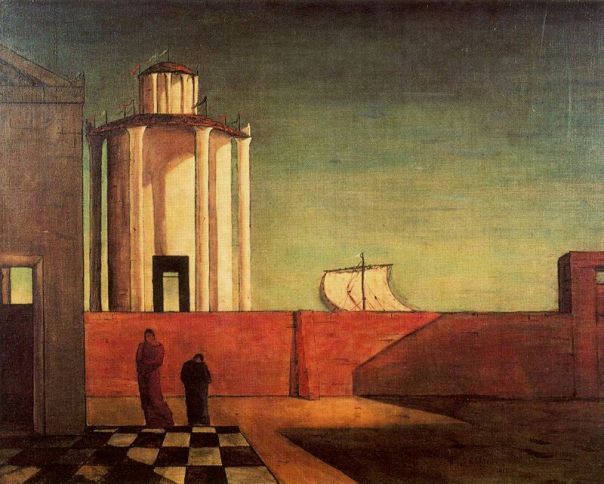
The Enigma of Arrival and the Afternon (Giorgio de Chirico, 1912)
Arrival is ambiguous. Both as a word with multiple diametrically opposed, context-dependent meanings … and also as an embodied social experience. Even if we humans did not have the capacity of grammatical, meaning-generative language to communicate with one another, our socially intensive, long lives entail that we would experience arrival in a much more variable array of manifestations, which would become thoroughly entangled in more complex memories, than do our closest ape relatives or would have our Miocene ape ancestors.
But we do have language. We construct stories and webs of symbols out of the underlying symbolic structure of grammatical, meaning-generative language(s), which we begin to learn already in our first months of life. And the word “arrival” (and its close translations in other natural languages) is an example of how referential symbols, even when they have many different meanings that could easily be confused in everyday social situations, focus our thoughts. Meaningful symbols direct our attention and often help us sustain it, as we continue to think and act. The symbols we use in everyday life don’t always have clear referents. When we begin tell a story about arrival, different listeners may start to imagine or assume how the narrative will unfold. It might be imagined as a story about arriving someplace new, about growth, challenge, discovery. Or as a story about return. It might be a routine arrival, part of a regular cycle of departure and return. Or it might be truly unusual, a once-in-a-lifetime experience. Using the efficient symbolism of the same word, “arrival,” for all of these different patterns, each instance of which would inevitably be constituted by unique circumstances, our imaginations exploit this arbitrary common thread tying together the successive experience of different arrivals with the experience of remembering or telling about arrivals. And thus, symbolic language helps us remember, helps us to imagine the similarity and difference between self and other, helps us to connect disparate experiences that might be separated by decades. Helps us to connect our own experiences to fictional events or abstract notions related to arrival: beginning, ending, the cyclical and recurring, the temporally directional and changing, the known and unknown, the forgotten and remembered.
I would suggest that the use of words–whether initially constituted by learned hand-gesture or vocalization sequences–would have been favored by natural selection, for pointing toward concrete states of affairs quite immediately relevant for bodily homeostasis and that of kin on an hourly or daily basis (monitoring for predators and dealing with hunger, thirst, thermoregulatory balance, exhaustion, caring for dependent juvenile offspring). Symbolic pointing, as Michael Tomasello (2008) has so eloquently and rigorously argued, allows the individual to influence the attention of others, and with eye-contact and constant monitoring, spoken discourse allows dyads or larger groups to manage joint attention. And this would be particularly advantageous for survival in a more open vegetation pattern in the terrestrial habitat that our ardipithecine and australopithecine ancestors had adapted to between ca. 7 – 3 million years ago in East Africa. Especially when food and water resources were diverse, heterotrophic, and often difficult to find and extract. Simple noun utterances referring to people, things, and actions could be combined with bodily gestures and gaze direction to negotiate small-group movement and activity in the hominin omnivorous, terrestrial, extractive niche that was then evolving. But arbitrary word symbols–taken by learned convention to point toward something quite concrete, like a particular kind of fruit, seed, or animal prey–can easily acquire a more general, ambiguous, or abstract referent in a socially intense environment, as long as the speakers maintain the word-symbol usage. The initial evolutionary limitation for cultural increase in lexicon size in late Pliocene or Pleistocene hominin groups would have been on the anatomical, time, energetic, and social cost of sending or understanding a message. But there would have been persistent selective pressure favoring more efficient, rapid, varied utterances and more effective understanding and memory, simply because being able to learn and point to more particular kinds of situations in the near environment would enhance survival and reproductive success. And because such simple linguistic pointing to nearby, recently witnessed or soon-hoped-for states of affairs in the environment would reinforce mutual monitoring and cooperation, the resulting increase in sustained social interaction and joint attention would support learning of words for general categories of food, pronouns, and basic but environmentally compassing events, like sunrise and sundown … or social states of affairs, like arrival.
And with learning of such symbols pointing to general phenomena that sit in a higher nested hierarchical relationship to specific events or things (“arrival,” “animals,” “plants,” “food,” “stone,” “baby,” “adult”), our hominin ancestors would have been able to focus their imaginations and memories on stories or scenarios in which self is compared with other. This, even before natural selection would have favored further cognitive processing power to learn many additional symbolic grammatical items, so that such imagined or remembered stories could be uttered and shared. Whether this evolutionary process took place relatively earlier or later, slightly more quickly or more slowly, it would have been a gradual one. But the evolution of our linguistic capacities would have co-occurred with the construction of our niche as a conspicuously socially intense one. There would have been a positive, reinforcing feedback in natural selection, favoring the capacity to learn and to send more–and more varied–symbolic messages, and these with more varied referents … in turn, favoring the networks of sustained social relationships in which these symbols and their variable referents would have been invented, learned, and exploited. And in this context favoring participation in larger social networks with more sustained, interdependent social relationships, the embodied and logical focusing effect of arbitrary symbols, which sustain an individual’s attention in imagination on patterns of shared experience with others, would have supported the evolutionary emergence of “theory of mind” and empathy. A new person I’ve never met before has just arrived in the valley. How would I feel if I were the stranger arriving, hungry, tired and thirsty, in a new group?
But more general, abstract words–with their multiple, context-dependent referents, however learned and sustained through interaction in multiple, complex, intense, constantly negotiated, interdependent social relationships–are ambiguous. Language helps us to adapt socially to a really complex niche. We can share information about parts of the environment beyond what we can immediately see, hear, or smell … And we can plan jointly with others, cooperating to exploit resources in those out-of-immediate-reach parts of the environment. The arbitrary nature of words as polysemous symbols has a more surprising logical effect. In focusing the imagination, abstract words like “arrival” can logically support or evoke thoughts that constitute human consciousness, in fundamentally contrasting existence with non-existence, being with nothingness, life with death as the negation of life. And this would in turn produce the individual’s consciousness of family and society as constituting the universe, existence of the world. This is fundamental to understanding why human culture is more than just learning and information sharing. Culture is also the process of consciousness logically leading us to construct narratives and images of the social relationships on which we depend as integrally tied to cosmological order. And these stories and images move us.
REFERENCES
Tomasello, M. (2008). Origins of Human Communication. Cambridge, MA, USA: MIT Press.
A recent article on plant chemical behavior has received press attention because the researchers have shown that plant cells can effectively carry out basic arithmetic calculations. The article–by Scialdone et al., in press in the journal e-Life–describes experimental results confirming what researchers have theoretically expected, based on mathematical calculations about biochemical behavior. Basically, it appears that after a few hundred millions of years of terrestrial plant evolution, genes in the cells of leaves produce different proteins that keep track of how much starch photosynthesis has produced in each cell during the day AND how long it’s recently been dark at night over the past few days. Starch catabolism is key for the plant at night, since energy from the starch fuels the organism’s physiological maintenance and growth. And the pace of starch degradation and mobilization appears to be critical. Plants appear to have the capacity to use available starch during the nighttime, so that starch runs out almost exactly at dawn. Regardless of how plants achieve this, the authors note, “[i]n the model plant Arabidopsis thaliana this phenomenon is essential for productivity: mutants with defects in either the accumulation or the degradation of starch have reduced productivity and exhibit symptoms of starvation.” Scialdone et al. (in press) combine formal mathematical models with laboratory experiments in which they control Arabidopsis plants’ day-night cycles. The result is that plants are able to update circadian clock information about changes in night-time duration, while using up starch at a rate so that–as long as the laboratory scientists don’t drastically change the duration of nightime from day to day–their energy source runs out right around dawn. The neat chemical trick is that some proteins are sensitive to the amount of starch, carrying out reactions in the cells at a rate directly proportional to starch granule availability, day and night; other proteins are sensitive to the duration of daylight and nighttime. The enzymes that directly facilitate starch degradation interact with circadian rhythm enzymes, so that starch degredation enzyme concentration is influenced by current starch quantity, but also limited by the circadian-rhythm enzymes, whose concentrations relate to time to dawn.
This is an analog way of carrying out a continuously updated division problem: starch is consumed at a rate that equals current starch availability level divided by how much time is expected to be left until dawn. Consumption = Starch Amount ÷ Time Left Till Dawn.
The authors state, “Our analysis here has underlined the utility of analog chemical kinetics in performing arithmetic computations in biology. Importantly, we have for the first time provided a concrete example of a biological system where such a computation is of fundamental importance.” It is very likely the case that activity in networks of neurons are maintained and modulated by similar analog biochemical systems. Thus, many cognition researchers would agree that the way we store information in our brains about what’s happened in the past, so that it can modify bodily responses in the future, involves chemical feedback systems that are shaped by–and thus represent–environmental stimulus patterns from the recent past (see Chemero 2009). In fact, chemical concentrations of different kinds of biomolecules–from neurotransmitters to hormones to a range of other cellular enzymes and DNA transcription factors–can mutually influence each other in our bodies, thus storing information that is distributed not just in our central nervous system but throughout our bodies. No one would argue that plants are intentionally carrying out division problems. And in fact, we’d be much worse than plants if we had to measure our own food-levels consciously and constantly, and also measure information about how long that food will have to last in the near future, so that we could slowly but constantly sip away at that food until we can reasonably expect to get more. Natural selection on DNA over a huge time period has favored a robust chemical system in plants, adapting their metabolic cycle to day-night rhythms in the environment. But the demonstration of how chemical concentration feedback systems can store and apply information in Arabidopsis plants gives us a tantalizing hint about the more complex web of cellularly, physiologically, and anatomically structured biochemical feedback systems underlying embodied human thought and consciousness. Thus, the difference between human consciousness and plant starch utilization is not entirely night-and-day.
REFERENCES
Chemero, A. (2009). Radical embodied cognitive science. Cambridge, Mass.: MIT Press.
Scialdone, A., Mugford, S. T., Feike, D., Skeffington, A., Borrill, P., Graf, A., … Howard, M. (2013). Arabidopsis plants perform arithmetic division to prevent starvation at night. eLife, 2. doi:10.7554/eLife.00669
Even before Darwin, it should be remembered, scientists contemplated the notion that different kinds of organisms evolve–that is, have evolved in the past and conceivably continue to evolve. And that the evolution of living organisms has to do with adaptation over many generations of reproduction.
The evidence for adaptation through differential reproduction over the generations–driven by differential fitness of the variety of heritable traits in a population … of bacteria, oak trees, people …–is unambiguous. Yet, the implications for how we think about life remain challenging. In my experience, this is particularly the case on two levels. First, biology students have difficulty–especially initially–staying focused on evolution as a gradual process of complex change in differential reproduction over thousands generations. Second, instructors–especially those who have limited background in biology, say, in teaching an introductory anthropology course–have difficulty, more often than one would expect, in combining clear presentation with effective exercises and discussions that would better help students really own and use accurate knowledge of long-term evolutionary processes and outcomes. The evolutionary process is indeed complex, because what changes (again, over many many generations) is simultaneously:
random mutation rarely but persistently altering how bits of DNA function, sometimes increasing the fitness of a given bit in the environment, sometimes decreasing it
the characteristics that those more fit bits of DNA build or influence, as they chemically shape phenotypic “vehicles” for their own survival and reproduction (Dawkins 1982a, 1982b)
variation in adjoining bits of “neutrally fit” DNA that have succeeded in hanging on for the ride while accumulating harmless mutations
the sustained or accumulated, often ecologically structuring impact of DNA’s chemical, usually complex and indirect influence on those phenotypic vehicles that have already been favored by previous generations of natural selection … with the critical, pervasive effect that DNA indirectly but systemically, cumulatively changes its environment over long time-frames (Odling-Smee et al. 2003)
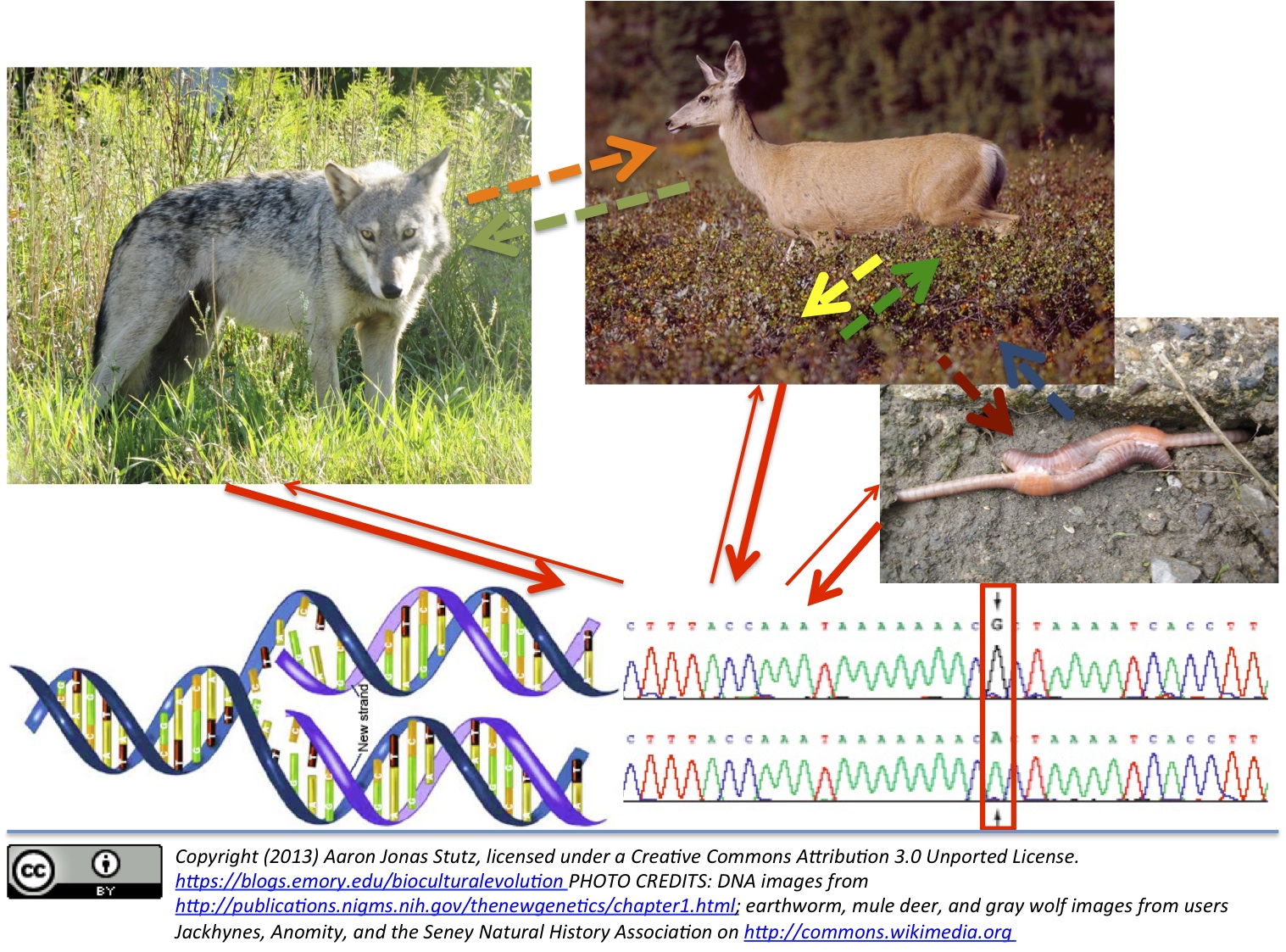
Populations of DNA shape phenotypic “vehicles” that are better or worse fit to their environments. Occasional random mutations in DNA replication produce variations among DNA strands in the vehicles (anatomical, physiological, biochemical, behavioral) that they build or influence. Those DNA strands producing better-fit vehicles will be more likely to survive and replicate. The long-term interesting result about life on Earth is that DNA populations shape complex environments, even as those cumulatively-forming environments structure which DNA variants subsequently survive and replicate. Due to random biochemical copying errors (a.k.a. mutation), DNA maintains a constant potential to change the environment, no matter how resilient an ecological balance has emerged in the environment, through food-web and habitat modifications. Thus, constantly DNA stands in a non-nested systemic hierarchical relationship to its environment.
The intricacy of this process may best be conceptualized with a series of abstract notions, like populations and allele frequency change. But at the intro level, just trying to get your head around these thoughts can deaden what provokes curiosity about evolution: birth, maturation, aggression, cooperation, sex, and death in nature. BTW, I had to go with the language “more fit bits” once it popped into my head, since it sounds somewhat disgusting, even a bit obscene. BUT … but hopefully you’ll remember the bigger point about why students find it especially difficult to conceptualize the evolutionary process.
Now note that the complexity of evolution is not irreducible. It is reducible to how DNA chemically functions, impacting its environment, and in turn influencing which DNA-chain variants survive and copy themselves more effectively in that environment. While scientific knowledge always philosophically involves doubt and acknowledgment that there are unknown phenomena in the universe, science is also an active stance for seeking explanations for observable phenomena that involve natural causes or processes. (This perspective is, of course, contra what proponents of “intelligent design” try to sell us on, where it is claimed or hoped that God comes in, every once in a while–allowing us to witness biochemical systems or anatomical structures, at least in some organisms, that exhibit such complexity so as to defy the very physics or chemistry according to which those organisms’ genes are naturally supposed to have evolved or operate. Such claims very simply amount to hoping–because of an a priori belief in divine intervention in nature–that repeatable, independently verifiable observations do indeed record phenomena that scientific inquiry will never ever be able to explain. Among other profound philosophical problems with Intelligent Design–the perspective of which takes a seemingly tactical step away from the Biblical literalist point of departure of so-called “Creation Science”–is this: it is really arbitrary which poorly understood observable phenomenon is left open to scientific curiosity and investigation and which is asserted to be so complex that we can decide here and now that said complexity is evidence of an active divine hand in nature. And this makes Intelligent Design not only a willfully ignorant stance, but also very corruptible, highly susceptible to arbitrary appeals to phony scientific authority.)
Getting back to what evolves in evolution, I would emphasize four absolutely key take-homes from the above brief summary of the evolutionary process:
Evolution does indeed happen in populations of organisms whenever there is change in DNA diversity from one generation to the next … and thus, evolution is not really that interesting in the short-term … but it is happening.
IT’S FEEDBACK, PEOPLE: evolution is understood to occur without irreducible complexity, exactly BECAUSE DNA impacts–and thus changes–its own environment, even as random mutation in this theoretically infinitely long biopolymer causes variation in DNA’s very function … including complex interactions among its own chemical products in and around cells … In other words, DNA regulates its own chemical self-copying function–albeit with occasional copying errors (a.k.a. random mutations)–at the same time that it influences other chemical products in its own environment, in which the chemical replication proceeds … so that sometimes DNA has a strong non-nested hierarchical filtering effect on the environment, although most of the time, the environment has a stronger non-nested hierarchical filtering effect on replicating DNA.
Evolution is interesting in the long-term–that is, over thousands or millions of years–because that’s when all the drama of birth, aggression, cooperation, sex and death emerges. The challenge is that it comes from the complex, occasionally shifting non-nested hierarchical feedback between DNA and its environment, and that leads to much more than anthropomorphically titillating drama … evolution has produced spectacular ecological phenomena that have given the planet Earth a richly dynamic but resilient biosphere–one that’s survived all forms of physical change on the planetary level (plate tectonics and volcanic eruption) and solar system level (oscillations in the Earth’s orbit and variations in solar radiation intensity) over a couple of billions of years.
It’s worth being interested in points 1. and 2. BECAUSE if you’re interested in 3., then the first two points help you answer a lot of questions and even ask some new, really smart ones.
This is more than just my two cents, as a college instructor in biological anthropology, for why deeper understanding of evolution is worth the effort and how students might begin to answer AND ask better questions about why life works the way it does. As virtually all biologists would emphasize, everyone agrees that evolution in DNA allele frequencies goes on all the time–and in all forms of reproducing populations, from bacteria to trees to whales. But not everyone agrees on the reasons why long-term evolution is most interesting. In scientific discussion and research there arises all kinds of logically derived, yet diverging views about how to analyze the relationship between boring, short-term allele-frequency changes over a few generations and complex, interesting patterns, which may range from DNA function to organismal development to food webs to major adaptive radiations of species … and even to mass extinctions. Among the best known scientific debates about emergent evolutionary process unfolded in the 1970’s and 1980’s: Does speciation, extinction, and adaptation follow a gradual or a punctuated equilibrium proces (Eldredge and Gould 1972; Gingerich 1984, 1985; Gould and Eldredge 1977)? Are common phenotypic traits in populations best assumed to be adaptations shaped by natural selection or structural connectors or place-holders that really have nothing to do with adaptation (Gould and Lewontin 1979; Mayr 1983)? Have most fixed alleles in populations evolved by random drift, despite being selectively neutral (that is, having no influence whatsoever on vehicles that might favor or disfavor replication in the prevailing environment) (Kimura 1983)? Is the branching history of species best reconstructed by phenetic or cladistic analyses of their traits (Gingerich 1985; Stuessy 1987)? Should species be considered individuals (Vrba 1984; Vrba and Eldredge 1984; Vrba and Gould 1986) or should we really mainly focus on the “long reach of the (selfish) gene” (Dawkins 1982b)? No one said that science is easy, but it should be done right, and these theoretical and technical debates were part of the scientific process of trying to get the answer right: asking the right questions, using the right models, making the right measurements, carrying out the right analyses, so that observations could be replicated by other scientists and the research questions, methods, and conclusions all logically connected. Many of these debates have been eclipsed by the flood of data that has come over the past 25 years or so. Now, thanks to increasing computational power and DNA sequencing technologies, biological researchers have begun developing methods that integrate genetic, ecological, biochemical, physiological, anatomical, and behavioral information. And this helps us better understand the connections between areas of biological inquiry that have been all too often over-specialized.
So … despite lingering and often intellectually challenging and productive debates about philosophical approaches to the complex process of evolution, we have to stay focused on key ideas. That is, clear ideas that facilitate our integrating different questions about how DNA-environment feedback–fundamentally involving DNA replication–structures the big picture emergent phenomena. And putting aside debates about whether species are individuals or genes should demand more of our scientific concern, I’d emphasize one clear idea that helps us to getting back to basics, about how DNA-environment feedback can shape diversity in patterns of birth, maturation, aggression, cooperation, sex, and death. Even as populations of DNA strands evolve (keep that image in your mind clearly), they co-evolve with the environments they shape–and in turn, shape their fitness as replicating molecules. Thus, DNA is always evolving, but what we see evolving with DNA is a matter of scale at which we observe and investigate, whether we focus in on biochemical details of DNA function in cells, speciation and extinction, or the resilience or fragility of the whole biosphere that has shaped our evolution, even as we humans impact it.
REFERENCES
Dawkins, R. (1982a). The extended phenotype: the long reach of the gene. Oxford; New York: Oxford University Press.
Dawkins, R. (1982b). Replicators and Vehicles. In King’s College Sociobiology Group (Ed.), Current Problems in Sociobiology (pp. 45–64). New York: Cambridge University Press. Retrieved from http://www.stephenjaygould.org/library/dawkins_replicators.html
ELDREDGE, N., & Gould, S. J. (1972). Punctuated equilibria : an alternative to phyletic gradualism. In Schopf, Thomas J.M. (Ed.), Models in Paleobiology (pp. 82–115). San Francisco: Freeman, Cooper and Co.
Gingerich, P. D. (1983). Rates of Evolution: Effects of Time and Temporal Scaling. Science, 222(4620), 159–161. doi:10.2307/1691072
Gingerich, P. D. (1984). Punctuated Equilibria-Where is the Evidence? Systematic Zoology, 33(3), 335. doi:10.2307/2413079
Gingerich, P. D. (1985). Species in the Fossil Record: Concepts, Trends, and Transitions. Paleobiology, 11(1), 27–41. doi:10.2307/2400421
Gould, S. J., & Lewontin, R. C. (1979). The Spandrels of San Marco and the Panglossian Paradigm: A Critique of the Adaptationist Programme. Proceedings of the Royal Society of London. Series B. Biological Sciences, 205(1161), 581–598. doi:10.1098/rspb.1979.0086
Gould, Stephen Jay, & Eldredge, N. (1977). Punctuated Equilibria: The Tempo and Mode of Evolution Reconsidered. Paleobiology, 3(2), 115–151. doi:10.2307/2400177
Kimura, M. (1983). The Neutral Theory of Molecular Evolution. New York: Cambridge University Press.
Mayr, E. (1983). How to Carry Out the Adaptationist Program? The American Naturalist, 121(3), 324–334. doi:10.2307/2461153
Odling-Smee, F. J., Feldman, M. W., & Laland, K. N. (2003). Niche construction: the neglected process in evolution. Princeton: Princeton University Press.
Stuessy, T. F. (1987). Explicit Approaches for Evolutionary Classification. Systematic Botany, 12(2), 251–262. doi:10.2307/2419319
Vrba, E. S., & Eldredge, N. (1984). Individuals, Hierarchies and Processes: Towards a More Complete Evolutionary Theory. Paleobiology, 10(2), 146–171. doi:10.2307/2400395
Vrba, E. S., & Gould, S. J. (1986). The Hierarchical Expansion of Sorting and Selection: Sorting and Selection Cannot Be Equated. Paleobiology, 12(2), 217–228. doi:10.2307/2400492

 American culture is pervaded by violence in a way that surprisingly dramatizes the very legitimization of sovereign government power, from the local to the Federal level and back. This is not to say that as a society, the people of the United States are simply participating in a sham democracy. That would be a gross overstatement. What I argue is that in the United States democratic participation, justice, tolerance, and a willingness to make (reasonably, marginal) short-term sacrifices for a fairer, more sustainable society over the long-term–well, these are not the values that play the leading rolls in discourse about the people granting sovereign power to government. Rather, extraordinarily dramatic narratives–often implicitly understood and recapitulated through daily social interactions and choices–emphasize violence in creating a symbolically defining boundary between those who are a danger to ordered society and those who claim the right to be in that ordered, safe society. Thus, despite being a society in which opportunities for freedom are indeed extraordinarily wonderful, the United States simply falls short of the democratic ideals of equality of opportunity for life, liberty, and the pursuit of happiness … for the very reason that power is constituted by the act of violently, unfairly excluding individuals or groups from such opportunities.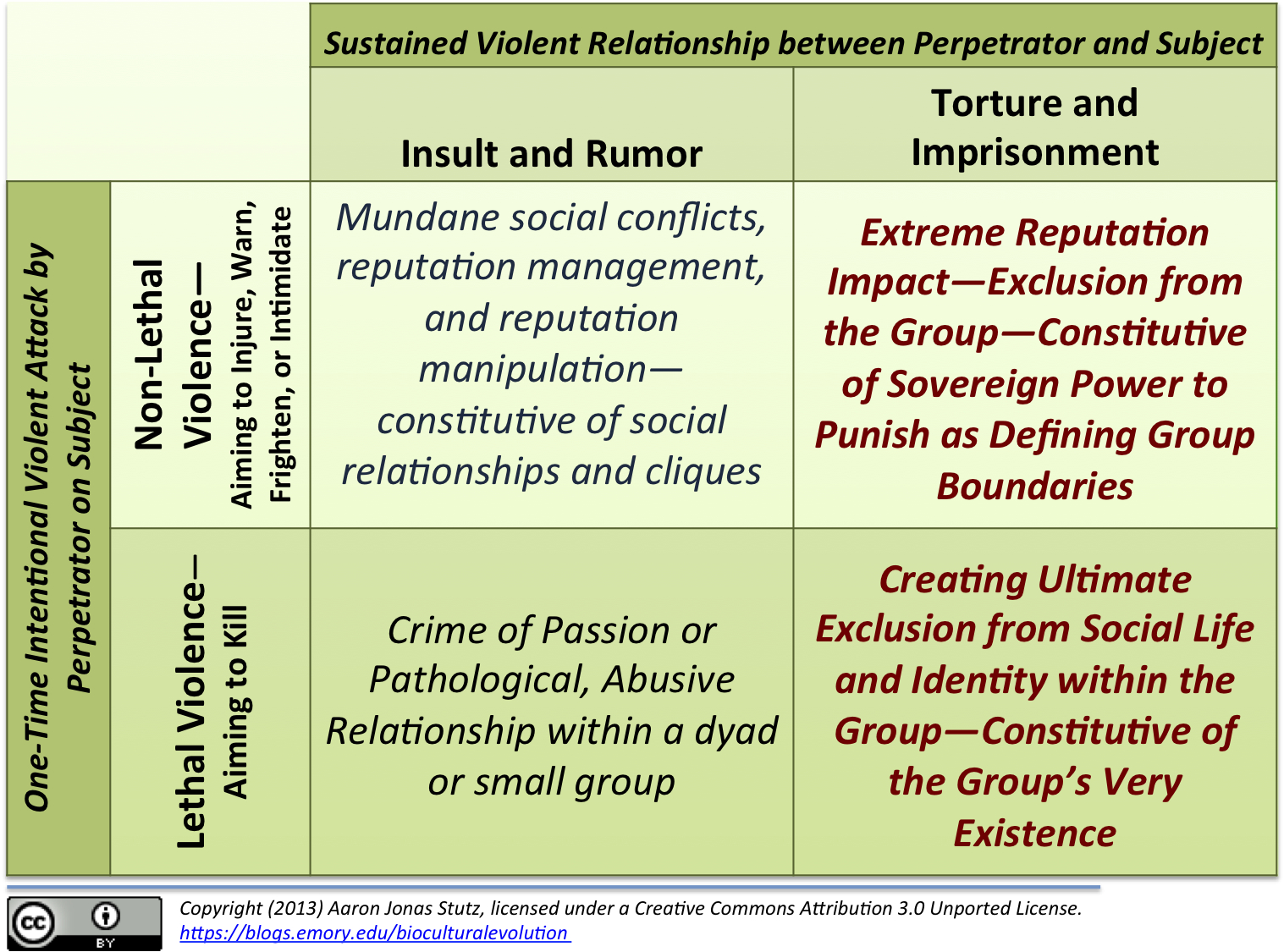



 The Biocultural Evolution Blog