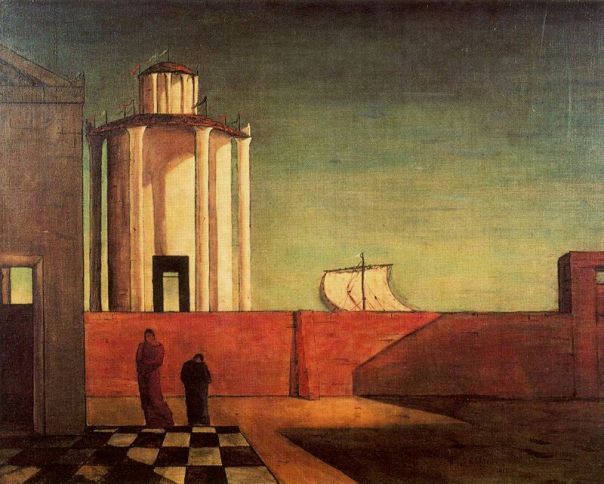
The Enigma of Arrival and the Afternon (Giorgio de Chirico, 1912)
Arrival is ambiguous. Both as a word with multiple diametrically opposed, context-dependent meanings … and also as an embodied social experience. Even if we humans did not have the capacity of grammatical, meaning-generative language to communicate with one another, our socially intensive, long lives entail that we would experience arrival in a much more variable array of manifestations, which would become thoroughly entangled in more complex memories, than do our closest ape relatives or would have our Miocene ape ancestors.
But we do have language. We construct stories and webs of symbols out of the underlying symbolic structure of grammatical, meaning-generative language(s), which we begin to learn already in our first months of life. And the word “arrival” (and its close translations in other natural languages) is an example of how referential symbols, even when they have many different meanings that could easily be confused in everyday social situations, focus our thoughts. Meaningful symbols direct our attention and often help us sustain it, as we continue to think and act. The symbols we use in everyday life don’t always have clear referents. When we begin tell a story about arrival, different listeners may start to imagine or assume how the narrative will unfold. It might be imagined as a story about arriving someplace new, about growth, challenge, discovery. Or as a story about return. It might be a routine arrival, part of a regular cycle of departure and return. Or it might be truly unusual, a once-in-a-lifetime experience. Using the efficient symbolism of the same word, “arrival,” for all of these different patterns, each instance of which would inevitably be constituted by unique circumstances, our imaginations exploit this arbitrary common thread tying together the successive experience of different arrivals with the experience of remembering or telling about arrivals. And thus, symbolic language helps us remember, helps us to imagine the similarity and difference between self and other, helps us to connect disparate experiences that might be separated by decades. Helps us to connect our own experiences to fictional events or abstract notions related to arrival: beginning, ending, the cyclical and recurring, the temporally directional and changing, the known and unknown, the forgotten and remembered.
I would suggest that the use of words–whether initially constituted by learned hand-gesture or vocalization sequences–would have been favored by natural selection, for pointing toward concrete states of affairs quite immediately relevant for bodily homeostasis and that of kin on an hourly or daily basis (monitoring for predators and dealing with hunger, thirst, thermoregulatory balance, exhaustion, caring for dependent juvenile offspring). Symbolic pointing, as Michael Tomasello (2008) has so eloquently and rigorously argued, allows the individual to influence the attention of others, and with eye-contact and constant monitoring, spoken discourse allows dyads or larger groups to manage joint attention. And this would be particularly advantageous for survival in a more open vegetation pattern in the terrestrial habitat that our ardipithecine and australopithecine ancestors had adapted to between ca. 7 – 3 million years ago in East Africa. Especially when food and water resources were diverse, heterotrophic, and often difficult to find and extract. Simple noun utterances referring to people, things, and actions could be combined with bodily gestures and gaze direction to negotiate small-group movement and activity in the hominin omnivorous, terrestrial, extractive niche that was then evolving. But arbitrary word symbols–taken by learned convention to point toward something quite concrete, like a particular kind of fruit, seed, or animal prey–can easily acquire a more general, ambiguous, or abstract referent in a socially intense environment, as long as the speakers maintain the word-symbol usage. The initial evolutionary limitation for cultural increase in lexicon size in late Pliocene or Pleistocene hominin groups would have been on the anatomical, time, energetic, and social cost of sending or understanding a message. But there would have been persistent selective pressure favoring more efficient, rapid, varied utterances and more effective understanding and memory, simply because being able to learn and point to more particular kinds of situations in the near environment would enhance survival and reproductive success. And because such simple linguistic pointing to nearby, recently witnessed or soon-hoped-for states of affairs in the environment would reinforce mutual monitoring and cooperation, the resulting increase in sustained social interaction and joint attention would support learning of words for general categories of food, pronouns, and basic but environmentally compassing events, like sunrise and sundown … or social states of affairs, like arrival.
And with learning of such symbols pointing to general phenomena that sit in a higher nested hierarchical relationship to specific events or things (“arrival,” “animals,” “plants,” “food,” “stone,” “baby,” “adult”), our hominin ancestors would have been able to focus their imaginations and memories on stories or scenarios in which self is compared with other. This, even before natural selection would have favored further cognitive processing power to learn many additional symbolic grammatical items, so that such imagined or remembered stories could be uttered and shared. Whether this evolutionary process took place relatively earlier or later, slightly more quickly or more slowly, it would have been a gradual one. But the evolution of our linguistic capacities would have co-occurred with the construction of our niche as a conspicuously socially intense one. There would have been a positive, reinforcing feedback in natural selection, favoring the capacity to learn and to send more–and more varied–symbolic messages, and these with more varied referents … in turn, favoring the networks of sustained social relationships in which these symbols and their variable referents would have been invented, learned, and exploited. And in this context favoring participation in larger social networks with more sustained, interdependent social relationships, the embodied and logical focusing effect of arbitrary symbols, which sustain an individual’s attention in imagination on patterns of shared experience with others, would have supported the evolutionary emergence of “theory of mind” and empathy. A new person I’ve never met before has just arrived in the valley. How would I feel if I were the stranger arriving, hungry, tired and thirsty, in a new group?
But more general, abstract words–with their multiple, context-dependent referents, however learned and sustained through interaction in multiple, complex, intense, constantly negotiated, interdependent social relationships–are ambiguous. Language helps us to adapt socially to a really complex niche. We can share information about parts of the environment beyond what we can immediately see, hear, or smell … And we can plan jointly with others, cooperating to exploit resources in those out-of-immediate-reach parts of the environment. The arbitrary nature of words as polysemous symbols has a more surprising logical effect. In focusing the imagination, abstract words like “arrival” can logically support or evoke thoughts that constitute human consciousness, in fundamentally contrasting existence with non-existence, being with nothingness, life with death as the negation of life. And this would in turn produce the individual’s consciousness of family and society as constituting the universe, existence of the world. This is fundamental to understanding why human culture is more than just learning and information sharing. Culture is also the process of consciousness logically leading us to construct narratives and images of the social relationships on which we depend as integrally tied to cosmological order. And these stories and images move us.
REFERENCES
Tomasello, M. (2008). Origins of Human Communication. Cambridge, MA, USA: MIT Press.
international corporations who produce, maintain and service that infrastructure
and all the individuals–many of whom only have very local interests–who consume media and transmit information on that very instantaneously global electronic infrastructure
Edward Snowden’s now very instantaneously global story brings into focus just how thoroughly electronic communication and information storage is shaping the nation-state/multi-national corporation/individual connection.
And this drama involves a very general anthropological issue: how does the story–and how we tell it–interrelate with actions, and even the very formation of institutions that define and support the human actors involved, as the story continues to unfold? Again, the basic anthropological concern: the represented, told, and retold story–as it constitutes and is constituted by actors and institutions.
So, my main thought about Edward Snowden’s story–as we understand it to have occurred so far … and as we wonder how it will continue–is how influential actors interpret and tell their story within the larger story that we follow through professional news outlets and social media … with the literally influential effect that those actors have on why we tell ourselves the story itself is relevant. Because I’m not sure there could be one single person (at least among those paying attention) who has one single reason to feel that Snowden’s story is relevant. And among the multiple reasons for relevance, most of us face a bewildering challenge of prioritizing the most important one. What’s more relevant? How we use the story to construct a value of patriotism, identifying or contrasting our allegiance to country with Snowden’s? How we develop beliefs about the motives of government and private corporate institutions? How we define values about privacy? Civil courage? Of course, those influential actors–Snowden himself, his lawyers, government officials, politicians, journalists, Wikileaks leaders–tell stories within the bigger story, emphasizing the relevance of certain values and beliefs, at the expense of others. A major part of human social action is in using the representation of stories to convince yourself, to convince others, about what’s really relevant–among multiple conflicting rationales for concluding that a certain value or belief is really worth acting on … now, in the past, or in the future. What’s captivating for an anthropologist about the Snowden story is the extraordinary intersection of nation-state institutions, information technology corporations with global reach, and individuals who intensively use that digital information technology to be part of local and global networks. When we take a step back and consider the whole system, we can see how little nation states conform to philosophical definitions as legitimate institutions for justly maintaining social order while granting rights to citizens. We can see how thoroughly the transnational information-technology corporations influence us, as well as the nation states who define our citizenship (or lack of it). We can see how much our own seemingly clear notions of citizenship depend on stories–the symbolic logic of which focuses our attention on belonging and rights, versus exclusion and withdrawal of rights. This, even as digital information technology helps corporations and nation states to act as if those stories were simple convenient fictions. AND … this, even as digital information technology supports virtual networks of individuals to interact globally, across nation-state borders, sharing evidence and accounts that allow us to pull back the curtain on how nation states and private corporate institutions jockey for power, as they further interact with transnational institutions that are indistinctly legal or widely considered illegal–including off-shore banking networks, organized criminal organizations with hacking and cybercrime operations, and violent political organizations.
A big part of globalization today is that nation-state claims of sovereignty and power may use digital information technology, but they are built the old-fashioned way. That is, through a combination of control over technologies of violence and surveillance within their borders, use of violent technologies to control the definition of borders and what passes through them, and ideological stories that compel us to see the violence as absolutely necessary and just, constituting the very order we live in. This is hardly to say that all nation states are actually necessarily illegitimate organized crime organizations that convince us of their legitimacy, so that we ignore the excessive and unjust violence, arbitrary invasion of privacy and surveillance, and seemingly random assertion of control over the very material conditions of our existence. Rather, all nation states–no matter how well democratic participation and rule of law are protected and followed–face the temptation to exploit ideological stories, surveillance technologies, and arbitrary violence to shape claims of sovereignty within and beyond their borders, and all individuals face the temptation to believe in particularly dramatic and often highly convincing or comforting ideological stories. I would argue that the very fundamental temptation to prioritize as relevant and believe ideological stories about the nation-state, order, and the necessity of violence has to do with just how complicated and conflicting our interests and actions are, along with those of transnational corporations and nation-state institutions … And how complicated and expensive it would be to invest in those priorities that would be most relevant to our freedom, quality of life and opportunity in the future–whether it might involve reigning in off-shore banking networks that facilitate all sorts of money laundering; successfully fighting organized-crime networks who traffic people, drugs, and weapons for enormous profit; investing in renewable energy technology; developing more sustainable agricultural practices or public transportation infrastructure; or providing wider access to healthcare and education. Best to keep things simple, anchored in stories that shape our beliefs about where order, right, and belonging come from. Even when, as anthropologist Keith Hart has thoughtfully discussed, individual well-being, freedom, and creativity may be better served in working toward a humane–or in his terms, a human–economy, involving novel, flexible, transparent digital information systems that support local networks of social exchange and obligations, while also securely and reliably linking them to national and international ones.
It is important to remember that, like face-to-face linguistic communication, electronic communication itself involves: the sender’s message formation, encoding, and transmission, and on the other end, the audience’s reception, decoding, and re-encoding of the message … into a form that may be easily perceived, understood, and thought about. BUT … unlike face-to-face linguistic communication–which is the first kind of communication humans learn as part of our co-evolved niche and adaptations–electronic communication is technologically structured to separate as a discrete sequence the encoding-transmission-receiving-decoding-re-encoding process. SO … when we flesh-and-blood humans are involved in linguistic communication with other humans, we are conspicuously acting as dual senders and receivers in real time; we use recursive embodied cognitive operations to form non-verbal thoughts while simultaneously encoding them as linguistically sensible ideas, and just as importantly, we speed up the decoding process by making usually pretty good inferences about what message content we might be receiving in the coming seconds. There is a lot of parallel thinking, multi-sensory perceiving and inferring that accompanies the uttering and hearing in any human linguistic back-and-forth. But when we are involved in electronic communication, we use really complicated technology to send and receive messages. And it is with this technologically aided communication where we separate all that real-time, social-interaction-based, parallel multi-sensory embodied cognition and insert a discrete encoding-transmission-receiving-decoding-re-encoding process. Thanks to silicon chips, fiber optic cables, and mobile satellite/cellular tower networks–as well as traditional metal telephone cables–this discrete sequences occurs at the speed of light, so we experience the back-and-forth of a telephone, Skype or FaceTime conversation, without even worrying about the technology. The technology facilitates parallel embodied cognitive processing and communication between flesh-and-blood humans in real time, bringing us closer and making geographic scale seem irrelevant.
But the technology that now involves digital–rather than analog–encoding and decoding of messages makes it possible to intercept and store transmitted information at relay points … without hindering individual users’ experience of instantaneous communication. The infrastructure for this global electronic communication is–not surprisingly, but easy to not care about on a day-to-day basis–really complicated and expensive, having been built up over decades of private investment, government-funded research and public (but not infrequently classified/secret) investment, and economic growth around the world. As Hart has discussed, the lines of communication and information storage–including technologies for encryption and decryption–can allow truly creative local networks, not just for communication, but also for the construction of alternative currencies, facilitating negotiation of exchange and obligations. Critically, these networks can be defined according to currencies that are independent of national and international ones. Yet, as Hart has further explored, there is potential for linking local networks, where most of us create our sense of identity and belonging, to wider systems of interaction, exchange, and obligation, providing new opportunities for control.
The challenge, though, is enormous. And it’s an old one–fundamental to the very phenomenon of biocultural evolution. How is social judgment and punishment to be defined, mobilized and carried out, so that cheaters and free-riders don’t undermine local, more democratic currencies of exchange, credit, and obligation? It’s just that technology–rather than face-to-face negotiation and interaction–is much more integrated into the system, increasing the potential for creativity and freedom, but also for control, arbitrary violence, manipulation, and the temptation to cheat.
Back to Edward Snowden’s story itself. Even if Snowden acted in good faith–that is, in accord with his stated democratic value of limiting secret US government intrusion into private individuals’ communication–he is now in a situation where the Chinese government has been able use him as a pawn to score domestic political points, in supporting an “American dissident,” and where the Russian government faces (and may have already given into) the awful temptation to extract/extort from him detailed information about US National Security Administration cyberspying programs around the world. Although Snowden may have acted out of a personal value of patriotism as an American citizen, he is a highly vulnerable intelligence asset. And thus, he appears to be caught in a tragic narrative, where he is cruelly exploited by one nation-state institution, thus reinforcing the narrative that he is a traitor to the nation state that gave him citizenship from birth.
It would be wise for all of us around the world to consider that digital information technology connects us, allowing a wonderful potential for creativity, interaction, and exchange, but it can be exploited by nation-state institutions in ways that go substantially beyond, say, domestic spying for the purpose of discovering terrorist plots. Nation states themselves are constituted as key global actors when bureaucrats and politicians tell stories and make decisions that prioritize the relevance of digital information technology in a very different, encompassing way: as a hedge for maintaining surveillance within established borders now and in the future; as a tool for expanding surveillance and the effectiveness of violence beyond national borders, in the ongoing process of power-jockeying with other nation-states; and as an instrument for building and maintaining an efficient power advantage over transnational corporations and organizations considered legitimate and illegitimate, alike. Edward Snowden’s story should focus our attention on an even bigger story of which we are all part, where fundamental biocultural processes of institution formation, power production, and the emergence of inequality undermine the potential for achieving–as Keith Hart has described it–a truly more democratic human economy.
The biocultural evolutionary perspective in Anthropology encourages students at all levels to answer really broad questions, getting at really complex phenomena. Here, I present the learning focus--that is, what students by the end of the semester should be able to understand and explain to themselves and others--that I include on my Anthro 101 syllabus ... on the first page. The ideas and methods of inquiry involved in Boasian Four-Field Anthropology are diverse, and all contribute to answering these "fairly big questions." Here, it is worth considering how creative inquiry, problem-solving, documentation, discussion, and critical reflection over answers to these questions constitute both an interdisciplinary science of humanity AND a life-long approach to addressing problems of organizational effectiveness or environmental impact in our complex, rapidly changing world. Anthropology is good for promoting problem-solving, tolerance, curiosity, and understanding today ... and well into the future.
What does Anthropology mean to you? I have often asked Anthro 101 students–virtually all of whom are first or second-year undergraduates at Oxford College of Emory University–to write a brief answer to this question on the first day of the semester. Not surprisingly, the answers reveal a range of familiarity with the discipline, from complete prior ignorance of the discipline’s existence (!!!) to keen interest in some area of Anthropology, with an intention to become and Anthro major. Occasionally, students at the start of their first Anthro course actually articulate that they are interested in figuring out how the it all fits together: where does inquiry into human biology and evolution connect with ethnographic research on cultural diversity and cultural difference? Still, even the most interested and informed students coming out of high school usually have developed a focus on one subfield within Anthropology. It is most often biological anthropology, followed by archaeology and cultural anthropology tied in a moderately distant second place. This probably reflects the dominance of intended pre-meds among our students, but it probably also reflects the more successful reach of human evolution and primatology documentaries and books with an evolutionary perspective. For the vast majority of undergraduates, then, the idea of a coherent Anthropology discipline with a conceptual foundation in biocultural evolution is not anywhere on the radar screen. Of course, as I have argued in my initial posts, the idea of such a coherent discipline is rarely encountered because anthropologists do not agree on what that coherent discipline might be … and whether we can commit to a coherent program of inquiry and debate over our shared biocultural inheritance and our diverse, ever-changing, and mutually shaped biocultural identities.
Indeed, many professional anthropologists don’t even have their own particular version of the biocultural perspective … or care about Anthropology as a coherent academic discipline. This, despite the fact that we continue to invest in the Boasian umbrella structure of four-field Anthropology in university, four-year, and two-year departments across North America, reaching the largest number of undergraduates in our introductory courses that cover the definition and some basic examples of biocultural connections (most often having to do with race or health). And this, despite the wider success–especially for producing educational materials effective at the high school level–of the truly bioculturally grounded American Anthropological Association’s public education program on race. I mean, doesn’t this actually suggest that the four-field departmental structure–in which most North American Anthropology faculty work–possesses at least a kernel of a good idea, which gets some interesting knowledge and perspectives across to a large number of undergraduates in liberal arts degree programs? I mean, isn’t the popularity of introductory Anthropology courses–and at many undergraduate colleges, Anthropology majors, minors, and interdisciplinary degree programs–an indication that students are gaining at least some significant transferable learning, communication, and critical thinking skills that prepare them for a wide range of professional careers and make at least some of them marginally more tolerant, open-minded, and engaged in social issues of fairness, justice, well-being, and sustainability? It’s as if the disciplinary structure of Anthropology–which we’ve inherited from Franz Boas’s late-19th century scientific and humanistic vision, and which supports the intellectually intriguing idea of our shared, intertwined biocultural identities–is succeeding despite the best efforts of most academic anthropologists.
Problem? Well, it depends on your point of view and interest. But I think it’s a huge problem. And it seems that cultural and biological anthropologists blogging on the topic agree. In fact, this particular post was motivated by my reading a recent essay by Ryan Anderson on his Anthropology in Public blog (which I got to via John Hawks). This bit from Ryan’s post “Anthropology: It’s Not Just a ‘Promotion’ Problem” really hit home:
In other words, most anthropological writing remains highly technical and of interest to other specialists within our various anthropological subfields. It may even be rare for archaeologists studying prehistoric hunter-gatherers to be read by archaeologists studying historical empires, and vice versa. Meanwhile, we get frustrated that the most successful books on our research topics are written by journalists or Jared Diamond. And shortsighted criteria for hiring and promotion leave us with very little time to think through why our research and resulting insights have broader relevance for students and members of the public … and here, I mean broader relevance for substantially changing how people think, learn, communicate, and engage in the world.
SO WHAT IS ANTHROPOLOGY GOOD FOR, ANYWAY?
If you’ve read along this far, not only am I grateful that you’re this interested or curious. I would also suggest that the question of what Anthropology (and similar disciplines that also reach across the humanities-life science/qualitative-quantitative data divides and have overlapping research interests, such as Psychology, Sociology, and Linguistics) is good for is something that actually grabs you. You care about curiosity, scientific inquiry, critical self-reflection, and rigorous liberal education, with a foundation in improving your reading, writing, and critical thinking skills, integrating effective, evidence-based logical argumentation. We have to remember that with the potentially conflicting interests of undergraduate education (which helps universities and colleges to pay the bills through tuition) versus success in research (which brings in the prestige, grant money, endowed chairs, and other donor money), there are a number of logical symbolic story lines that align the attention and interests of otherwise critical Anthropology faculty members with the still-too-often shortsighted aims of deans and provosts and trustees, so that we prioritize research, publishing books and peer-reviewed articles, and sending out new PhD’s into the world. We want the best trained, most interesting, cutting-edge thinkers (or their highly recommended recent PhDs or post-docs) as faculty members in our own departments. And our administrations want faculty who will contribute to the university or college brand. Fortunately, there are so many good anthropology instructors out there–or like me, anthropologists in love with the discipline enough to work their asses off to become good teachers over time–managing great teaching material. So the other interest of having a good undergraduate courses and popular majors is also often achieved. But not in the service of a clear curricular and intellectual vision.
Now it should be clear that I think Anthropology on the undergraduate level is especially good at engaging students in developing really important transferable communication and critical thinking skills, while encouraging curiosity, critical self-reflection, and a commitment to engaging in society (rather than just consuming goods and services while avoiding democratic responsibilities). Anthropology is good for higher liberal arts education. Anthropology is good for encouraging life-long learning, open-mindedness, and democratic engagement.
But all academic disciplines should be able to engage students and the public in such general learning goals, influencing our basic communication and thinking skills and our commitment to tolerance and community engagement. I would go further and suggest that the biocultural perspective brings in something unique about Anthropology’s idea content and practical methods of inquiry. I would argue that at any level, students of Anthropology learn to rely on more varied methods of inquiry, with more varied, complex kinds of evidence, in order to figure out how parts in complex human systems influence one another and create larger patterns of organization and change. In doing so, Anthropology students can be much more creative, but also much better at documenting and explaining their questions, methods, results, and insights, while reinforcing a commitment to such collaborative, critical inquiry. The problem is that many of us in Anthropology end up becoming incredibly specialized in terms of knowledge and methodological expertise, barely able to speak with–let alone inspire collaboration with–colleagues in complementary areas of inquiry. I am not saying that I should be able to carry out ethnographic research as well as I can draw and describe an archaeological stratigraphic profile, but I should be able to provide my cultural anthropological colleagues with thoughtful, critical comments on their work, and vice versa. And although I am primarily a Paleolithic archaeology expert, I should be able to teach undergraduates the basics of ethnographic field methods … and do so in an inspired way, because of an engaged interest in my students’ inquiry into questions about the symbolic structure of social practices in interesting contexts. Anthropology needs a commitment to ideas, creative methodologies, discussion, and complex scientific problem solving for approaching BOTH very particular aspects of biocultural inquiry AND ALSO the really big picture of biocultural evolutionary emergence.
Perhaps the most effective way of illustrating the diversity and comprehensiveness of Anthropological inquiry across the subfields is in figures. Here, I summarize some of the big questions of the biocultural perspective, taken from the main content-based learning goals of my Anthro 101 syllabus (above left), along with a table outlining key areas of inquiry in the different subfields, and the methods involved in that inquiry (below). It shouldn’t be surprising that Anthropology has the potential for extraordinary insight into humanity, our biocultural origins, and our constantly changing biocultural identities … with all of the broader relevance for understanding any complex human organizational system and its impact on the environment.
Biocultural evolution in our genus has largely involved dynamic, often non-equilibrium mutual perturbations between the complex, hierarchically structured environment and hierarchically structured cognitive sense of landscape, time, and social identity.
In working on the Human Niche Overview post, I spent some time refining the figure at left. In it I tried to characterize aspects of the human niche encompassing the social and the cultural, so I could provide a succinct summary of niche-adaptation co-evolution as biocultural evolution in the genus Homo. I’ll go into more detail about the “Adaptation” side of the figure in later posts. In this post I focus on the unusually complex–but rarely acknowledged–hierarchical structure of the human niche. The hierarchical dimensions of our niche arguably drive what I described as (o.k., a hyphenation bonanza here) the “recurrent non-equilibrium niche-adaptation evolutionary dynamics” that characterize biocultural evolution over the long-term. For now, concerning the “Adaptation” side of the figure, I would like you to think a bit about why I have made the leap and very specifically included as a distinct human adaptation cultural symbolically structured, embodied representations that contextualize ego in society, landscape, and time.
Now, let’s focus on the niche side of the evolutionary dynamic. Tooby and Devore’s (1987) “cognitive niche” is certainly evocative in getting us to think about niche as encompassing the social and symbolic environment. Recently, Steven Pinker (2010) and Andrew Whiten and David Erdal (2012) have provided elaborations of the idea. The problem with this approach, I think, is that “cognitive niche” tends to blur niche and adaptation.
So in the figure above, I’ve tried to build on the “cognitive niche” approach by making clear what’s niche and what’s adaptation. On the niche side of the figure, I ordered key features or dimensions, so that early hominin–and even modified Miocene ape–aspects of niche that the genus Homo inherited are shown on the bottom. The basic evolutionarily primitive aspects of the genus Homo‘s niche are thus terrestrial, heterotrophic, and extractive. (In my Foundations of Behavior course, I use the mantra “terrestrial, omnivorous, extractive niche” to help student stay focused on the general environmental structure shaping selective forces on biological variation over six or seven million years of hominin evolution. This year–and it’s taken years, for some reason–a few of my students working in a study group hit upon the “T.O.E.” acronym. Not a bad mnemonic for also integrating niche-adaptation co-evolution involving bipedal locomotion.) The social structure of early hominins, including that of australopithecines and earliest Homo, up to ca. 2 million years ago, remains susbtantially the subject of speculation (Chapais 2013). But theoretical arguments and archaeological evidence do support the conclusion that later, with the emergence of Homo erectus around 2 million years ago in Africa, the human niche underwent a long-term trend of increasing social intensity and complexity (Gowlett et al. 2012). From birth to senescence, members of the genus Homo would have joined, exploited, negotiated, and been challenged by larger social networks, with more complex and frequent clique and alliance shifts, than our earlier australopithecine ancestors and extinct relatives experienced. Certainly, a dynamically evolving but evolutionarily derived aspect of niche in Homo was–and is–that of social intensity.
But it is more than just social intensity. There’s another, rarely recognized–but potentially illuminating–pattern. It involves multidimensional hierarchical structure…on both the niche and adaptation side of things. This requires a bit of explaining. Hopefully, though, the pay-off will be a more useful framework for investigating the emergence of (o.k., here it is again) recurrent non-equilibrium biocultural, niche-adaptation co-evolution dynamics in our genus over the past 2 million years.
WHAT’S THE BIG DEAL WITH NON-NESTED HIERARCHICAL ORGANIZATION?
Quickly, an upfront acknowledgment: After searching occasionally through ecology articles and texts, over a period of years, trying to track down a serious general theoretical treatment of hierarchical organization in living systems (hierarchy and scale aren’t the same thing, and there’s a lot more on scale relationships in ecology than there is on hierarchy), I finally realized that it would help to search directly for “hierarchy,” rather than “scale” or “complexity.” I’m stubborn, if not efficient, in my work, but when I got it right, I finally found Allen and Star’s (1982) … wait for it … Hierarchy: Perspectives for Ecological Complexity. Anyway, when I talk about filtered dynamics between systemically related structures in the human niche, I’m relying 100% on Allen and Star’s explanation that non-nested hierarchical relationships are best modeled as one system component asymmetrically dominating the other(s). Higher levels in a non-nested hierarchy tend to filter out information transmitted from lower levels, so that they respond in a less sensitive way. Lower levels filter less, and thus, they are more influenced by the higher levels. An example would be how somatic cells have a non-nested hierarchical relationship below tissues and organs. Although tissues and organs influence individual cells much more than vice versa, there are definitely situations (e.g., cancerous growth) where higher integrated tissue or organ structures and functions are sensitive to information from cells. Moreover, with metastasizing cancer, the cells are not strictly nested within the tissue or organ structure. Another example that Allen and Star highlight is how overlapping, long-lived generations constitute a non-nested hierarchical system, in which older generations have a net greater influence on the fitness of younger ones, in a non-nested, asymmetric pattern. In fact, inspecting the form of Robert May’s classic model of intergenerational lags in fitness effects, Allen and Star point out that May’s formal model has the form of an analog acoustic filter in sound engineering! In general, the concept of non-nested hierarchy couldn’t be more helpful for explaining how natural systems could gradually evolve more complex integrated structures. How this applies to the human niche–specifically with spatial, temporal, and social non-nested hierarchical structures–will become clearer with some of the examples below (I hope).
NON-NESTED HIERARCHY IN MODERN HUNTER-GATHERER SPACE, TIME, AND SOCIAL RELATIONSHIPS
I’ll start with a well-understood connection to my main area of expertise, Paleolithic archaeology. Archaeologists Glynn Isaac and Lewis Binford were especially influential in integrating ethnographic information about hunter-gatherer societies with research on our Paleolithic prehistory, and they implicitly emphasized the hierarchical structure–in spatial, temporal, and social dimensions–of small-group daily foraging combined with home-base/mobile camp food preparation and sharing. Isaac’s main point was that in human evolution, along with the evolution of stone-tool-making and hunting behaviors in the late Pliocene or early Pleistocene, the foraging “home base” would have been at the center of a complex behavioral nexus supporting cooperative hominin groups. Hunting and gathering behaviors are best understood not just in terms of searching for and getting food, but also bringing food back to home bases. Thanks to Isaac’s insights and arguments, we almost take for granted this cooperative-foraging/food-transport/sharing behavioral system as obviously constituting an evolutionarily emergent foundation of human society. But this system is subtly complex. Binford further helped to put hunter-gatherer mobility patterns into evolutionary perspective. Frequent formation and movement and re-establishment of residential camps can structure socially based hominin adaptations over larger foraging territories. Thus, the hierarchical structure starts to come into focus. We tend to have a multi-level hierarchical pattern in human hunter-gatherer experience–mapped out in space, time, and social networks. Here, daily routines are hierarchically structured … and then daily and seasonal patterns of residential moves through territories and with a larger configuration of allies and kin constitute the annual round at the next hierarchical scale.
Let us consider the hierarchical structures of this behavioral system in ethnographically documented hunter-gatherers more carefully. Returning our focus to niche-adaptation co-evolution, might we be able to separate out what’s niche, what’s adaptation, and how they might have influenced each other? I would suggest that the hierarchical structures interconnecting humans across the landscape, through time, and in varied social network configurations have constituted an aspect of niche that imposes clear selective pressures on embodied and social cognitive functions. In turn, because the selective pressures are on embodied and social cognitive capacities, the resulting symbolically structured experience of landscape, time, and social relationships can become part of the niche itself. Let’s consider the spatial, temporal, and social aspects in turn, just in the context of daily foraging, food transport, and processing/consumption routines.
First, spatial hierarchy. Even in highly mobile hunter-gatherer societies, the daily routine is recognizable. Food search and acquisition involves following a novel path (Yellen 1977), potentially covering several kilometers from the home base and back. Yet, the home base is a spatially fixed landscape anchor, at least on a time scale of days, weeks or months. Spatially, the home base strongly “filters” the distances and locations involved food-search, food-capture, field processing, and transport behaviors. In turn, impact on food resources in the area around the camp dynamically filters cooperative decision-making to stay or move camp. However, the strength of the filtering effects tends to be asymmetric, so that social central-place food processing and consumption maintains a hierarchical influence over foraging behaviors. And importantly, the hierarchical spatial relationship between home base location and area covered in foraging and food transport is not strictly nested. Groups can establish a seasonal camp by a nut grove or tuber-rich lake shore, so that the hierarchical camp-foraging relationship can temporarily disappear for a matter of days or weeks, at least in certain seasons of the year. In early Stone Age prehistory, it would have been more common–in many environments–for hominin groups to snack more while foraging (eating as they went), so that the filtering effect of the mobile residential camp on foraging and transport would have been weaker and more variable. Still, this spatial hierarchy involving foraging behaviors diverges from the eat-as-you-go pattern we see across the rest of the primate order, including behaviors exhibited by chimpanzees and bonobos, our closest living relatives.
Second, home-base or residential-camp foraging involves an intrinsically embodied socio-temporal hierarchy, in that food acquisition and consumption are thus more often substantially separated (of course, ethnographically documented hunter-gatherers snack on raw or rapidly processed foods in the field, but most food is consumed after transport to the residential camp). Delayed consumption is a conspicuous, altruistic behavioral adaptation. And again, it structures the human niche in terms of temporal hierarchy within daily embodied routines. The fitness benefit of such altruistic behavior–despite carrying risks of inviting aggressive, continuous, or simply emotionally irritating theft or begging–comes in terms of the recurrent reciprocity payoffs of sharing food at the residential camp (Winterhalder 1986). But consider the social implications of this temporal daily-routine cycle, with leaving and returning to the base camp. With what would presumably be a fission-fusion process on this timescale of hours, smaller foraging groups would tend to include close allies or kin, and time spent would involve mainly cooperative behavior. Episodes of attempted free-loading, cheating, intimidation or attempted theft during a foraging trip would have a greater cost for all involved. Foraging group members would generally be working harder, be hungrier, and to the extent that cooperation improves food search and acquisition efficiency, any attempt to free-load or cheat could thus provoke rapidly escalating aggressive conflict. We would expect foraging trips to involve mainly consensus decision-making and cooperation, with more occasional episodes of bitter conflict. In contrast, the larger base-camp experience would be a period of negotation, more complex (and potentially less reliably accurate) information exchange about reputation of many group members, along with recuperation and the experience of satisfying or limiting hunger. In brief, hunter-gatherer routines would tend to have a non-nested (that is, not strictly) hierarchical separation of more focused, consensus-built small group foraging activities, and more dynamic, emotionally variable, socially intense camp experiences. The emphasis on sharing, reconciliation, gossip, consumption, rest, and less relevance for high levels sensory alertness (monitoring signs for prey, predators, or other important opportunities and dangers) entails that time in camp is less sensitive to what happened on each and every foraging trip. It should be clear that, on the one hand, this is a non-nested hierarchical structure of foraging and consumption behavior that is evolutionarily uniquely derived compared to other primates, but on the other hand, the emphasis is on “non-nested.” As such, the hierarchical temporal structuring of experience as part of the niche in hominins is something that must have evolved gradually over time. This is a topic worth exploring in much greater depth! What was the timing, tempo, and mode of this particular socio-temporal aspect of hominin niche construction?
THE NON-NESTED HIERARCHICAL STRUCTURE OF NICHE AND THE EVOLUTION OF HUMAN LANGUAGE
If we begin with this common space-time-social-configuration hierarchical structure to daily routine in human foraging societies, then we can easily begin to see how space, time, and social interaction exhibit complex hierarchical structure at higher scales. We can even consider that common cultural representations may often emphasize nested hierarchical ideals, and these can actually serve as ideological symbols in negotiating exchange, allegiance, future plans, or declarations of shared identity. In other words, members of a group may think or speak of the boundaries of their foraging territory, with landscape beyond that imagined boundary being, by definition, the rest of the universe, so that logically, the nesting relationship is: our total foraging territory and other hunter-gatherer groups’ total foraging territories fit into the larger conceptual category of the universe. But in reality, group composition, cultural representations of group identity, and the position of asserted, desired, or agreed-to territorial boundaries all shift. So, embodied routines and experiences interact with cultural representations, tending to produce beliefs or values reifying the notion of hunter-gatherer group territory.
More generally, the hierarchical spatial, temporal, and social structures of embodied routines in group contexts will never follow a strictly nested pattern. In fact, on the level of daily routine, even when logistical mobility practices are uncommon, foraging trips might result in an overnight stay. Sometimes, individuals or groups won’t even go out to search for food, reversing the spatial, temporal and social associations of food search/acquisition trips versus staying in the residential camp. So instead, non-nested hierarchical spatial, temporal, and social structures of behavioral routines are statistical patterns in populations or individual life-history patterns that develop over time. Along with cultural representations of such hierarchical structure, the complex asymmetric relational structure of routines and their multi-dimensional rhythms are part of the niche that co-evolved with our cognitive, emotional, and communication adaptations. I would go so far as to suggest that we probably cannot sufficiently explain the niche-adaptation co-evolutionary dynamic involved in our ancestors evolved linguistic capacities–constituted by our ability to conceive, understand, and construct grammatical utterances, longer narratives, and complex, imaginative and evocative metaphors–if we don’t consider the complex non-nested hierarchical structures of humans in space, time, and social configuration.
REFERENCES
Chapais, B. (2013). Monogamy, strongly bonded groups, and the evolution of human social structure. Evolutionary Anthropology: Issues, News, and Reviews, 22(2), 52–65. http://dx.doi.org/10.1002/evan.21345
Pinker, S. (2010). Colloquium Paper: The cognitive niche: Coevolution of intelligence, sociality, and language. Proceedings of the National Academy of Sciences, 107(Supplement_2), 8993–8999. http://dx.doi.org/10.1073/pnas.0914630107
Tooby, J. & DeVore, I. (1987). The reconstruction of hominid behavioral evolution through strategic modelling. In: (W.G. Kinzey, ed.) The Evolution of Human Behavior: Primate Models, pp. 183–227. New York: SUNY Press.
Whiten, A., & Erdal, D. (2012). The human socio-cognitive niche and its evolutionary origins. Philosophical transactions of the Royal Society of London. Series B, Biological sciences, 367(1599), 2119–2129. http://dx.doi.org/10.1098/rstb.2012.0114
Winterhalder, B. (1986). Diet choice, risk, and food sharing in a stochastic environment. Journal of Anthropological Archaeology, 5(4), 369–392. http://dx.doi.org/10.1016/0278-4165(86)90017-6


 The Biocultural Evolution Blog