I am an anthropologist, with a primary research focus in bioarchaeology. I seek to understand more clearly how we have evolved intricately with our environment. After all, things and people have identities and histories defined by multiple, thoroughly intertwined dimensions. The challenge is that, when we--as scientists--start to define more rigid, logically sharp definitions, models, and research questions, we lose sight of those intricate, complex evolutionary feedbacks that transgress simpler physical and chronological units, like cells, organisms, and populations; days, years, and generations; inside, on, and beyond bodies. This holistic perspective--with my aim of making the complex a bit more comprehensible--is certainly reflected in my blog and other professional activities, from research to teaching, advising, and consulting.
Thus, I am a paleoanthropologist obsessively interested in better understanding in our joint biological and cultural nature. I have long been a professor with primary interest in undergraduate teaching and students’ liberal arts learning experiences. I am a field archaeologist who thrives on the intricate puzzle-solving challenge of figuring out patterns and associations among widely disparate, interdisciplinary observations and analyses. I am an anthropologist committed to rejuvenating substantial intellectual connections between now-fragmented cultural/humanistic and evolutionary/scientific approaches to understanding our diversity AND our shared biocultural inheritance. And I am an educator who seeks to find new ways to engage in and promote the values of critical thinking, scientific inquiry, thoughtful reflection, mutual respect, constructive communication, and lifelong learning. This is just my professional identity.
Key research themes that I discuss on the bioculturalevolution.net site include:
- niche-adaptation co-evolution in the human evolutionary lineage (the hominins)
- evolution of the human life history strategy (we grow up slowly and live a really long time)
- human sociality (we’re even more social–and socially interdependent–than our very close ape relatives)
- intergenerational transfer strategies (our sociality is strongly tied to how material, information, and social resources are transferred from older to younger generations)
- long-term demographic and health patterns (sociality and intergeneration resource transfers influence and are influenced by longer-term trends in demography and health)
- language, symbolic thought, embodied social practice, and technology (what more can I say?)
- the narrative and metaphorical nature of memory and its role in shaping ideologies of power and masking conflicts of interest in our complex social lives (social conflicts of interest are a highly derived hominin phenotype)
As a "medföljande partner" (accompanying spouse), I have now followed my remarkable wife Liv Nilsson Stutz to Sweden (which has long been my second home). I am currently developing my new site bioarkeologen.com, which offers osteological analysis, Swedish-English translation, academic English proofreading, data analysis and data presentation consultation, and educational modules in the key biocultural topics of disability and race.
View all posts by Aaron Jonas Stutz →
The “Medawar Zone”–as dubbed by ecologist Craig Loehle (1990)–refers to the scientific sweet spot between theoretical and methodological difficulty (horizontal axis) and methodological yield, in terms of increasing knowledge, clarity of description, and power of explanation or prediction (y-axis). Because knowledge and insight require comprehensible theories and effective methods, intellectual progress–however measured, whether by quantity or complexity of phenomena explained or by level of mutual academic understanding of a difficult-to-grasp phenomenon–is often confounded by a tangle of theory and method too simple to address new or more complex phenomena.
Anthropologists of very different sorts–whether they focus on genetics, on prehistoric stone tool technologies, or on the ontology of sovereign power–have a similar trick. All anthropologists utilize methodologies that involve zooming out and studying aspects of humanity that we can’t easily grasp within the myopic experiences that we usually have of our lives and surroundings, as we constantly work to discipline our emotions and actions in responding to daily challenges, in setting goals, and juggling competing obligations. In doing so, anthropologists bring into focus surprisingly intimate details about us. With what Claude Lévi-Strauss (1992) called “the view from afar,” anthropologists document, compare, and investigate important biological or cultural structures and processes that are at work on the scales of populations, societies, and beyond. Yet, many of the larger-scale structures and processes that anthropologists document and seek to explain in even broader comparative or evolutionary perspectives involve finer-scale features: bodily biological functions (like giving birth), embodied technological acts (harvesting grain stalks with a sickle), intricately evocative practices (telling myths or performing rites). And each of these embodied human phenomena–spanning the physical boundaries of our bodies, from within cells to contemporary world systems, and reaching across temporal scales, from the nanoseconds of biochemical reactions, to the multi-generational impact of the built environment and landscape on ongoing social interactions and experiences, and even to the biological inheritance of highly conserved genetic regulatory growth systems that have been maintained and tweaked by ongoing natural selection since initially evolving hundreds of millions of years ago in the common ancestor we share with all other animals–is embedded in a dynamic, sometimes shifting non-nested hierarchical relationship to the environmental phenomena, which in turn act at multiple spatial and temporal scales. What is important here is that anthropologists observe biological and cultural features embedded in these complex multiscalar contexts. This is what gives anthropologists a clear focus on the intimate, while also yielding insight into the general. The anthropological view from afar has the peculiar advantage of surprising depth of field.
But It is the Structure of Ritual that Moves and Shapes Us … and Shapes Our Social Boundaries
American culture’s violent streak isn’t unique; it’s just striking as a contradiction to the otherwise peaceful, deliberative values inherent in democratic rule and decision-making. The reason that symbols of violence can be effective in creating common identity in any community–at pretty much any scale–is that these symbols add drama to rituals and myths that move us. Of course, rituals and myths that move us–creating strong shared emotional associations, memories, and the basic embodied know-how and understanding for acting effectively in society in the future–do not require violence. Thus, in contemporary entertainment media, professional sports and competitive elimination-based reality shows incorporate various degrees of staged or symbolized violence and exclusion into ritualized settings, which we experience as marked excursions from the normal humdrum or challenge of everyday life and responsibilities. Because we can return from witnessing violence and exclusion, however aware we are that it is staged, we go about our lives again with a bit more resolve, ease, sense of security, or humor. Indeed, rituals in any form can shape our symbolic worlds AND our emotional engagement with them, essentially giving us the symbolic tools and emotional associations to make daily experience seem meaningful and worthwhile. Traditional rituals or ritualized entertainment that are peaceful, inclusive, redemptive, or cleansing can have just as strong an emotional and symbolic effect on us and the way we deal with the world.
Or: Why Is there Still So Much Symbolic Violence in American Political Culture?
Trepidation is the word … I’m not terribly politically outspoken, but having dived into the problem of symbolic violence in American political culture, I have to continue swimming. Because what is at stake, in my view, is whether anthropological analysis and inquiry can really contribute to constructive dialogue and mutual understanding, rather than adding to the usual mutual inflammation with which critical academic, “progressive,” or “left-wing” voices and conservative, religious, “patriotic,” “right-wing” voices afflict each other. My trepidation comes from the fact that I have described the violence in the narratives that have moved Americans and shaped power relations, directly in contradiction to the values logically inherent in participant, deliberative democracy. It is clear that conservative political positions will tend to be those that support status quo power relations already historically shaped by violent narratives of exclusion–of Black people, Native Americans, poor immigrants of all sorts, the poorest and neediest in general. (Again, if you think I’m exaggerating, remember how George Washington’s military suppression of the Whiskey Rebellion in 1794 resonated so strongly in symbolically legitimizing the early Presidency, Federal power, and the very constitution of the United States as a sovereign nation, within and without its borders.) Thus, in focusing on narratives of violence, I am bringing out into the open symbols and stories that reinforce conservative taken-for-granted positions. What I want to underscore, though, is that all humans have a tendency to be moved by dramatic, emotionally charged narratives of exclusion, as these have a mythologizing effect of defining the boundaries of ordered society. Defining certain people as outside of the cultural realm is dramatically constitutive of the boundaries of the cultural, civilized realm. To be sure, contemporary American conservative identities–from Tea Party conservatives vigorously seeking to scale back the role of government and taxation on every level, to evangelist Christians working to limit access to abortion or repeal Obamacare for purposes of defending religious freedom–are also strikingly shaped by violent narratives involving exclusion of others, especially involving the criminal justice and healthcare systems and the national security apparatus. Yet, the non-partisan albeit secular ritual–staged nightly on The Daily Show and The Colbert Report–satirizes hypocrisy, political expediency, and the absurdities of ideological political rhetoric, and in this ritualized context, Jon Stewart, Stephen Colbert, and their colleagues do not so much raise public consciousness and change daily engagement in democratic life, as they provide a shared experience in which the audience gets taken on a little, entertaining vacation from concerning political realities that many of us are just trying to deal with. These are rituals of political resilience that can create apolitical identity as much or more effectively as they can generate a symbolic focus on critical, thoughtful democratic engagement. Although Jon Stewart and Stephen Colbert have made extraordinary attempts to mobilize political engagement for a more reflective, critical approach to democratic participation and decision-making, they tend to constitute a small part of a the everyday lives of, at most, a minority of Americans. Secular rituals of exclusion in sports, however, get amplified in 24-hour sports media, on television, online, and on radio, paralleling the media rituals of exclusion in conservative and major progressive outlets alike. The other side is irrelevant or a threat to legitimate orderly, civilized democracy. I’ll admit up front that I certainly find myself on the side of many Democratic, progressive politicians, activists, and policy commentators when it comes to immigration, law enforcement, criminal justice and the prison system, voting rights, foreign and military policy, access to public education, and health care. This is because of the very reasons I’ve already outlined, that so much of our society is driven by violent narratives of exclusion, which have formed unjust ideologies of overwhelming political reaction. Yet, I can understand how and why many conservative Tea Party activitists, for instance, are so thoroughly shaped and moved by the narratives of exclusion in current immigration debates. I think we need a more comprehensive shift of engagement, one which may be ritually structured, but which must use contemporary electronic media in a creative, more effective way, emphasizing deliberation, respect, listening and a concern for mutually understanding the very basis by which diverse people create meaning in their worlds. How can we both invert the narrative from violence to compassionate inclusion and also increase awareness of how such narratives–whether inclusive or violently exclusive–tend to move our practices and beliefs, shaping our political values and engagement. Listen and be more aware of why you’re acting the way you do.
Can structural shunning–ghetto-izing someone so thoroughly that they are EITHER invisible to you OR relevant to you only as a reminder that you’re part of the in-group, powerful enough to keep the ghetto walls high enough–be even more dramatic that ethnic cleansing, ritual murder, or genocide? Greg Ellison, of Emory’s Candler School of Theology, points us toward taking this concern very very seriously.
As I’ve argued now in a series of posts, Trayvon Martin’s violent death has been part of a public ritual re-legitimizing the right to use lethal violence, to exclude in order to be included in the realm of safe, ordered democracy … revealing a cultural problem in the way that American democracy itself is constituted in practice, with society based on an excess of power, from local to international scales. What Greg Ellison suggests is that the expression “cut dead” refers to something we do all too often, whether we realize it or not; but the effects on those we exclude by shunning are simultaneously dramatically cruel, yet–and here’s the important thing–often sufficiently redeemable so as to create new, living social ties with them. While Ellison focuses on young Black men as all-to-often cut dead by the broader American society, he points out that “four fundamental needs—having a sense of belonging, control, self-esteem and meaningful existence—are phenomena that affect all humanity, regardless of race, nationality or faith background.”
I have not yet read his new book Cut Dead But Still Alive (Ellison 2013), but the theme is compelling. Because we need to stop and think about how “cutting someone dead” from wider society’s social, material, and emotional resources slowly, cruelly vitiates them. (From a biocultural perspective, this cruelty stems from the resilience and longevity of the evolved human life history strategy.) Moreover, Ellison describes his “mantra” as: Once you see, you cannot not see. It is not necessary to exclude in order to legitimate our own inclusion in the group and its resources. Moreover, it is important to highlight Ellison’s own projects of engagement, how he builds on seeing. As assistant professor of pastoral care and counseling, Ellison “plans to launch a grassroots community movement, titled Fearless Dialogues, led by a team of experts he has recruited from healthcare, politics, education, community organizing and the arts. Plans include intensive work in five cities …”
I would only add that getting involved in acts of restoring and rehabilitating the “cut-dead,” as hard and difficult and emotionally fraught as that may be, can dramatically invert the cultural symbolic structure of violent exclusion, emphasizing instead compassionate inclusion.
If something constructive is to come from the fraught cultural moment in America now–as debate, protest, and Presidential comment have bubbled in the wake of George Zimmerman’s acquittal of criminal culpability for killing Trayvon Martin–we have to focus on the symbolic yet mobilizing force of violent exclusion in all its forms. In my last two posts, I have commented on the Trayvon Martin case as generally important for becoming aware of the violent symbolic, exclusion-focused underpinnings of American political life. This is important, because so many of us respond to and participate in ideological stories of violent exclusion, and doing so makes American society inevitably incompletely democratic. At the same time, awareness of this widespread, fundamental cultural-political problem of violent exclusion has to grow from awareness, more specifically, of American racial identities as revolving around practices of Black exclusion. As American Anthropological Association President Leith Mullings has just written:
[as] a discipline, anthropology has a special relationship to race—the concept that figured so strongly in the Trayvon Martin case… Anthropology is the discipline that fostered and nurtured ‘scientific racism,’ a world view that transforms certain perceived differences into genetically determined inequality and provides a rationale for slavery, colonialism, segregation, eugenics, and terror. Our discipline also has a significant tradition of anti-racism that emerged from the tumult leading to World War II.
And as she continues to discuss, the divergent reactions or assertions about whether racism drove George Zimmerman’s actions … well, this socio-cultural divide certainly calls for explanation. Mullings adds:
Though prosecutors, many journalists and large segments of the public saw the case as a quintessential example of race profiling—there is ample evidence, many believed, that Zimmerman profiled the teenager because he was a young Black man—during and after the trial both teams of lawyers and the jurors tripped over themselves proclaiming that neither the murder nor the subsequent not guilty verdict had anything to do with race. How do we explain these startlingly different responses as to the role of race?
Issue #1: Did George Zimmerman, armed and actively monitoring his neighborhood for possible criminal activity, rely on racial profiling to decide that he should act on his kernel of suspicion about the boy who turned out to be Trayvon Martin? This issue is legally key, of course. If George Zimmerman was motivated by a simple racist stereotyped belief about what young black men in hoodies are like, it would be unambiguous that he had no right to “stand his ground” with his handgun. The testimony and evidence reported in the media suggest that, whatever other ambiguities might remain about the event timeline, Zimmerman actively chose to confront Trayvon Martin. Thus, there is a plausible case that he had no “stand-your-ground” right of self-defense, regardless of motivation, racist or not. Yet, Zimmerman’s lawyers successfully mounted a defense, asserting that time had elapsed between this initial confrontation and a subsequent one in which Martin ambushed Zimmerman. Here, whether or not the prosecution could have countered this argument more effectively before the jury is–on a fundamental level, although this is certainly zero consolation for Martin’s family–beside the point. It’s ambiguous whether George Zimmerman was motivated by racism. More importantly, he is thoroughly part of a culture of violent exclusion, one that is systemic and remains central to the social, practical constitution of American society. This broader, heterogeneous society–interconnected through the status, history, and institutional power of the United States of America as a sovereign nation state–is not focusing on the problem of violent exclusion. It is focusing on the problem of race. More specifically, of Black racial identity in relation to … White? Every other group that seems less dark? Because the legally admissible evidence of George Zimmerman’s racist nature–or lack of it–is limited, the American public clearly feels conflicted over the role of racism and racial identity in the case:
Issue #2: Was it right for Judge Debra S. Nelson to rule–during the trial proceedings–that the lawyers could not speak of racial profiling? This issue takes us beyond the ambiguity of whether Zimmerman was a racist, and it puts us smack in the middle of (and here it is): how race symbolically connects to moving narratives of violent exclusion. Such narratives emotionally engage and actively mobilize politicians, campaign donors, media commentators, and key voting blocs to create and support the institutions that, in turn, wield the sovereign power to use violence for exclusion and marginalization of individuals and groups, within and without US borders … in turn, creating new narratives of violent marginalization.
Basically, the judge’s instructions to the jury–and it’s inescapable to mention the observation that among those presiding over, arguing, or deliberating, no one was black–were to ignore racial identity and racism as factors to consider in the case. As legal scholar and journalist Marjorie Cohn recently reported:
Florida’s self-defense law prohibits “initial aggressors” from using force if their own conduct has provoked that force. So if a defendant “initially provokes the use of force” against himself, he cannot claim to have acted in self-defense, unless he withdraws or retreats.
The prosecution asked the judge to instruct the jury that it could consider who was the first aggressor in the altercation between Zimmerman and Martin. If the judge had agreed to give that instruction, the jury might have concluded that, by following Martin, Zimmerman provoked a physical response from Martin. The defense objected to the instruction, and the judge decided not to give the first aggressor instruction.
The jury was instructed to consider only whether Zimmerman reasonably believed deadly force was necessary to prevent imminent death or great bodily harm to himself – when he later tussled with Martin on the ground.
Again, the judge, the jury members, the defense lawyers, and the prosecution team included no people of color. Why is this relevant? After all, it’s rather likely that these key players in the Zimmerman case aim, in their everyday lives, to treat all people equally, without racial bias. More generally, although White racism is unfortunately not yet on the verge of extinction, it is safe to say that fewer and fewer White individuals in America harbor and act on racist sentiments, recoiling when others voice or act on racist notions. Yet, structural racism persists in many government and private institutions, involving mortgage lending, access to healthy foods, access to high quality K-12 education resources, and–of course–treatment in the legal system. My aim here is to threefold:
I want to explain why the bigger issue about race in the Trayvon Martin case stems from Judge Nelson’s removal of race from consideration in George Zimmerman’s trial.
I want to explain how widespread White denial of responsibility for racial disparities in health, education, and incarceration is intimately, but subtly, linked to narratives of violent exclusion that unjustly affect millions of Black people in the United States.
And I want to explain why–more generally–those in dominant social positions are usually unaware of the structural advantages that come from their position, but when the position is challenged or resisted, they are all-t0-often moved by narratives of violent exclusion.
As Leith Mullings and others have recently underscored, White-Black racial distinctions in America are–for the most part, of course–no longer produced by direct White segregationist rhetoric backed up by violent intimidation, but still, rhetoric about a color-blind, post-racial America is actually rhetoric mobilizing and supporting the political and economic interests of mainly older, White Americans at the expense of doing something substantial about the structural racism that disproportionately negatively affects Black, Hispanic, and Native American life experiences and opportunities. Given the dramatic statistics about racial disparities in incarceration, poverty, health, and school discipline/suspension problems, why does “color-blind” rhetoric succeed in diverting so many peoples’ attention from this well-documented persisting inequality? Especially when stories about racial difference as defined by group-level biological boundaries and differences are scientifically disproven (Hartigan 2010: Chapter 3) and have less societal, symbolic traction than ever? My argument is that Judge Nelson’s instructions not to speak of racial profiling–specifically addressing all-White lawyers and jurors–is very clearly an instance of “color-blind” rhetoric implicitly but clearly supporting the narrative asserting that non-Black identity is legitimated by morally justifiable exclusion–violent and lethal, if necessary–against young black men who are treated as outside the order of proper American society. And in turn, this is an instance of cultural myth creation, reinforced by the dramatic courtroom ritual, in which sovereign power production in America–while not an all-White privilege anymore–is produced at the expense of Black people seen as threatening.
From a biocultural perspective, I argue that we have to connect how symbolic relationships structure our social actions with something else: how continuous embodied, emotional experience in a material environment structures non-nested hierarchical value relationships among symbols. OK. I try to minimize jargon here, but I guarantee that it’s worth working through this way of stating things. Mainly because race is not biological. Rather, it’s something that has a duality fundamentally analogous to the wave-particle duality of electromagnetic radiation behavior. Seriously. Race is sometimes more appropriately analyzed in terms of symbolic relationships that structure and constrain our beliefs and actions. Race is other times more appropriately analyzed in terms of continuous work that we do, constantly experiencing our environment and adjusting our actions. In short, race is both a socio-cultural web of interrelated, mutually evocative symbols AND continuous bodily interaction with our environment. The result of the former aspect is that racial identities and relationships are defined in terms of symbolically evocative stories. The latter aspect means that we are doing, creating racial identities–our own and others’–so often that we’re not aware of the symbols affecting us and how our actions reinforce prevailing stories of racial identities and relationships. Perhaps most importantly, we don’t realize how often we are influenced by, and in turn, influence stories of exclusion and power that define racial identities in America.
Indeed, the process of culture is always symbolically structured, but it is also recurrently dramatized and emotional. Narratives of violent Black exclusion are mythologized and ritually produced, yielding symbols that legitimize the social order. The problem is, whereas the vast majority of White people can go about their mundane activities, interacting with the material and social world without substantial concern that they will be violently excluded, Black people are frequently–sometimes constantly–symbolically reminded that they or their Black friends or loved-ones are on the threshold of being unjustly singled out–often violently–for exclusion. The cultural effect: a non-nested hierarchical difference in social experience and awareness. White identity is broadly associated with Black exclusion as restoring or maintaining social order, and Black identity is based on awareness of the threat of exclusion.
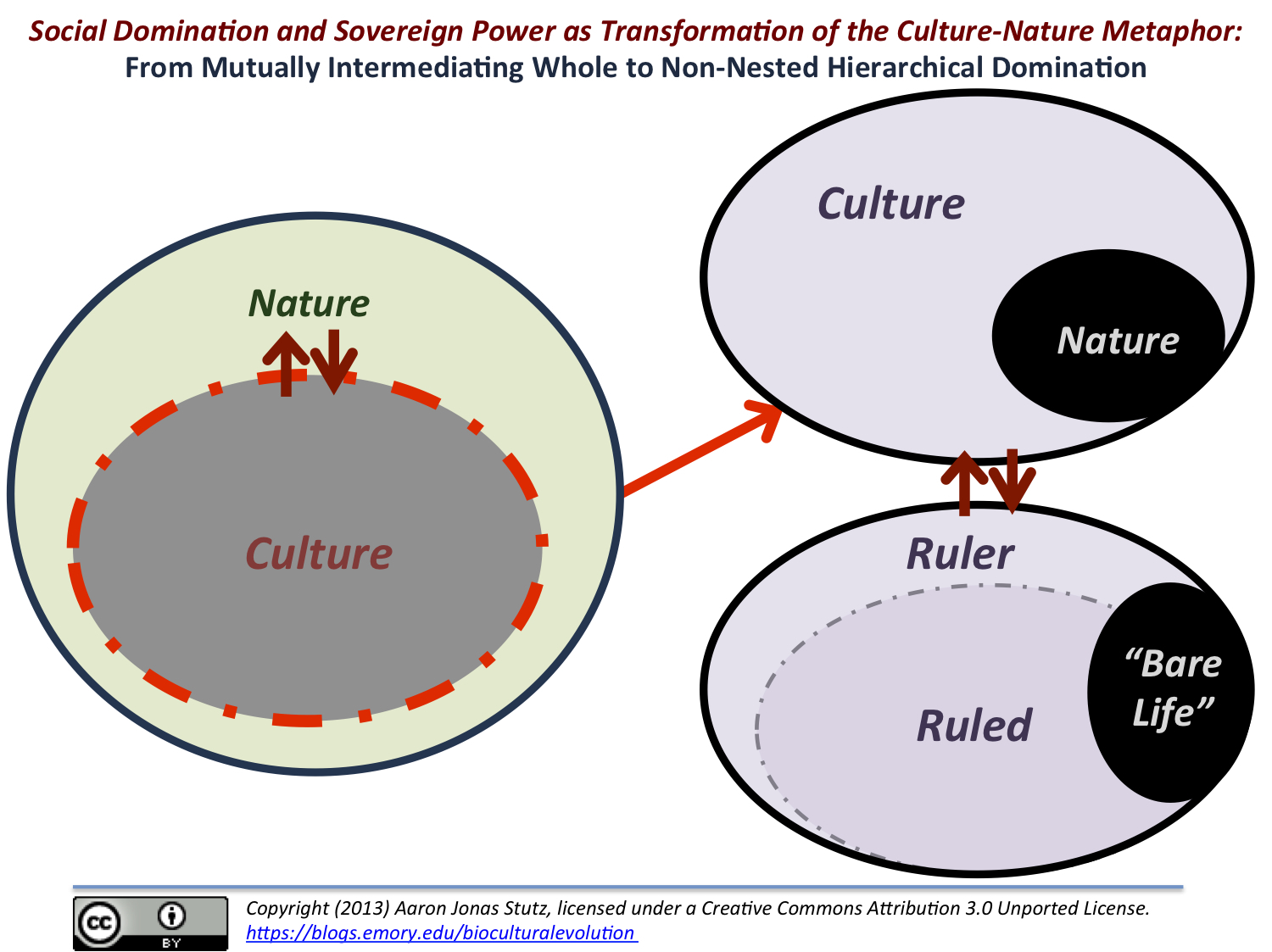
If we are members of a dominant group–the everyday identity of which is unmarked in relation to a dominated, marked group–we all to often allow ourselves to be moved, swept up in mythologized or ritualized narratives of violent exclusion. Here, individuals from the symbolically marked identity group are defined as subject to violent control–outside the bounds of moral society–in order to define bounds within which the dominant group’s moral life is not challenged or strained, is experienced simply as unmarked. The unmarked-marked relationship between social identity groups is central–in biocultural evolution–to the emergence of sociopolitically complex communities, in which sovereign power–as philosopher Giorgio Agamben (1998) has defined it–is successfully produced by creating a lacuna, a state or space of exception within the realm of the politically constituted AND cosmologically imagined universe, where violent exclusion strips some individuals to “bare life,” in order to dramatically, ritually legitimize the wielding of sovereign power. Thus, violent exclusion–whether symbolically based on race, gender, ethnicity, generational difference, religious sectarianism, socioeconomic class, or some intersection of these relational aspects of identity–can mobilize an excess of power, backed up by excessive force, in an otherwise democratic society.
One of the peculiarly pervasive and interesting general structural relationships that give meaning to the symbols we use–in terms of mutually defining contrasts between two articulated symbols–is what the linguists Nikolaj Trubetzkoy and Roman Jakobson developed as the unmarked-marked relationship (Waugh 1982). And as many anthropologists have observed, racial identities often are mutually defined in an unmarked-marked, non-nested hierarchical relationship–a relationship that makes the social advantage of the hierarchically more powerful identity seem natural, be accepted as taken for granted (e.g., Hartigan 2010).
In general, information depends on sufficiently clear contrast between symbols that are articulated spatially or temporally. And what Trubetzkoy and Jacobson identified in the early Twentieth Century, as they helped to pioneer modern linguistics, is that–in social practice–we bring some pairs of symbols into articulation, metaphorically revealing their contrasts in a conspicuously asymmetric way. As Waugh (1982) discusses, one of the clearest examples of this metaphorical process of asymmetric “bringing into awareness” is how contemporary English grammar usage asymmetrically contrasts present-tense with past-tense verb forms. The present tense is used not only to talk strictly about the present. It is also used to point toward situations in which time is not really relevant. “All dogs go to heaven” refers not just to dogs going to heaven now, but also to dogs in the past and future. The timelessness of the statement is not articulated in English through a special timeless tense. Rather, English speakers use the same form they would use when pointing to particular dogs and saying, “Those dogs go to heaven, too.” Thus, present tense is minimally evocative, establishing timelessness or lack of change over time as the default point of reference for picking up on contrasting symbols, pointing to information about temporal dimensions of the environment. When we use the past tense, though, it elicits a more specific detailed awareness of context and evocation. “Those dogs went to heaven” utilizes the verb tense to focus our attention on our temporal relationship to the dogs, the assertion of their heavenly ascent, and their individualness and concreteness compared to the generality of timeless aphorism, “All dogs go to heaven.” The basic metaphorical construction boils down to the analogy: present tense:past tense::generally non-evocative:specific and evocative. While complex and subtle, the unmarked-marked symbolic relationship of past to present tense in contemporary English grammatical usage reveals the dynamic, metaphorical, generative nature of thought and symbolic language. I would suggest that unmarked-marked symbolic relationships are particularly common because they constitute a kind of cognitive algorithm that compress representational data in our minds. As a consequence, we can more efficiently focus our attention on what is socially relevant, rather than sorting through the range of logically evoked related symbols in constructing relevant representations.
But what is especially key for understanding the construction of asymmetrically socially valued racial symbols is the fact that unmarked-marked symbolic relationships can contribute to potent political narratives. Indeed, as Waugh pointed out in her classic (1982) review of the marked-unmarked concept, Roman Jakobson already noted the political implications of Trubetzkoy’s initial observations about marked-unmarked relationships among phonological sound symbol patterns that, in turn, constitute distinctive, recognizable, meaningful word symbols in a spoken language. Jakobson observed that ideological claims for political power are often claims for unmarked symbolic status in relation to political opposition groups … or more generally, politically dominated or ruled groups. Waugh (1982:309) included the relationship between White (unmarked) and Black (marked) as a culturally familiar example of hierarchically, asymmetrically related identity symbols.
The unmarked-marked relationship is especially important for explaining the fact that White privilege exists statistically, relative to the distribution of opportunities or quality-of-life experiences of American people of color, although so many White people are unaware of their relative advantages, perhaps remaining more worried about marginal tax policies or how to get the best deal on their childrens’ student loans, whereas so many Blacks or Latinos are worried about the unfair treatment of their children or siblings in the criminal justice system. Basically, the way the unmarked-marked relationship works, especially between White and Black American identities, is that in most everyday activity and discourse, most White people are not confronted or challenged by experiences that would evoke the ideologically potent awareness of White-Black difference … and, possibly, the Black threat to order and safety. Thus, Whiteness is a social identity that is minimally evoked in the experience of those with greater resources and power. In contrast, most Black people experience daily life with repeated evocation of their Blackness in relation to Whiteness, with further awareness that they are EITHER invisible to most White people OR experienced by White people as a threat to order and safety (or perhaps, life, liberty, and the pursuit of happiness). If you think I’m exaggerating, please look closely at the Pew Center opinion survey results, broken down by racial identities, in the wake of the George Zimmerman acquittal. Here, the unmarked-marked symbolic relationship structures the social experiences and practices that continue to contribute to the racial disparity over whether America needs to talk more about racial relationships or whether we already talk too much about race. In the Pew sample, 60% of White adults stated that race is getting too much attention after the Zimmerman acquittal. 78% of Black adults stated that the Zimmerman case raises important issues about race that need to be talked about. John Hartigan, Jr., (2010) provides one of the best introductory overviews and analyses of ethnographic evidence for the unmarked-marked dynamic shaping White and Black identities in relation to one another.
UNMARKED IDENTITIES, POWER, AND NARRATIVES OF VIOLENT EXCLUSION
There are certainly many ways in which unmarked, socially dominant group identities have emerged over time and in different human communities. Indeed, the ways that dominant identities are constructed and maintained as unmarked are–at the very least–complex. The same community is likely to be constituted by cultural processes in which multiple dominant unmarked identities are opposed to marked counterparts, so that in some contexts, these identities seem entirely distinct, whereas in others, they may be metaphorically compared. Thus, unmarked male domination may be similar to White domination in some American social contexts, but in other settings, Black male identity may be symbolized as excessively wild, dangerous, possessing an excess of male potency and strength. Consequently, Black male identity can become metonymically represented as fundamental to Black identity as a whole. This can occur in narrative representations and in many White peoples’ emotionally constituted experiences, when challenged by resistance to the unmarked embodied assumption that Black men or Black people in general need to be controlled, their behavior, movements, speech contained, in order to maintain conditions of safety, so that White people can slip back into mundane routines without being aware of their social advantages… That such White narratives were already being recreated in the wake of Trayvon Martin’s shooting should not be surprising. It is interesting, though, that one of the most prominent political criticisms of Obama’s recent comments on the Zimmerman acquittal has come from a Black Republican politician: “Virginia Republican lieutenant gubernatorial nominee E.W. Jackson on Tuesday criticized President Obama for ‘racializing’ the Trayvon Martin shooting and distracting from the problem of epidemic violence among young people in the United States.” The narrative claiming that Obama is racializing (or re-racializing) the Zimmerman case is a way of claiming that it is OK for White people to ignore structural racism and that the violence inherent in such structural disparities is morally justified. The one (ironic) thing that is promising in E.W. Jackson making this claim–that is, from my perspective of seeking a more inclusive, fair, democratic society–is that the inclusion of non-White people in the dominant group will eventually undermine the racialized symbolic definition of the unmarked politically dominant identity. The problems that remain are twofold. One is that this effective deracialization is unlikely to occur until the violent domination and exclusion of mainly people of color–through structurally discriminatory public education, health, and legal systems–is brought to an end. The more profound problem, as I’ve argued in my previous two posts, is that stories of violent exclusion should not move us emotionally, should not blind us to the moral problem of using violence to exclude some people as we seek to define the boundaries of our ordered, safe society. We should not allow this violent non-democratic lacuna in our democratic society to continue to be ignored.
REFERENCES
Agamben, G. (1998). Homo Sacer: Sovereign Power and Bare Life (Meridian: Crossing Aesthetics). (D. Heller-Roazen, Trans.) (1 edition.). Stanford University Press.
Hartigan, J. (2010). Race in the 21st century: ethnographic approaches. New York: Oxford University Press.
Waugh, L. R. (1982). Marked and unmarked: A choice between unequals in semiotic structure. Semiotica, 38(3-4). doi:10.1515/semi.1982.38.3-4.299



 The Biocultural Evolution Blog