I am an anthropologist, with a primary research focus in bioarchaeology. I seek to understand more clearly how we have evolved intricately with our environment. After all, things and people have identities and histories defined by multiple, thoroughly intertwined dimensions. The challenge is that, when we--as scientists--start to define more rigid, logically sharp definitions, models, and research questions, we lose sight of those intricate, complex evolutionary feedbacks that transgress simpler physical and chronological units, like cells, organisms, and populations; days, years, and generations; inside, on, and beyond bodies. This holistic perspective--with my aim of making the complex a bit more comprehensible--is certainly reflected in my blog and other professional activities, from research to teaching, advising, and consulting.
Thus, I am a paleoanthropologist obsessively interested in better understanding in our joint biological and cultural nature. I have long been a professor with primary interest in undergraduate teaching and students’ liberal arts learning experiences. I am a field archaeologist who thrives on the intricate puzzle-solving challenge of figuring out patterns and associations among widely disparate, interdisciplinary observations and analyses. I am an anthropologist committed to rejuvenating substantial intellectual connections between now-fragmented cultural/humanistic and evolutionary/scientific approaches to understanding our diversity AND our shared biocultural inheritance. And I am an educator who seeks to find new ways to engage in and promote the values of critical thinking, scientific inquiry, thoughtful reflection, mutual respect, constructive communication, and lifelong learning. This is just my professional identity.
Key research themes that I discuss on the bioculturalevolution.net site include:
- niche-adaptation co-evolution in the human evolutionary lineage (the hominins)
- evolution of the human life history strategy (we grow up slowly and live a really long time)
- human sociality (we’re even more social–and socially interdependent–than our very close ape relatives)
- intergenerational transfer strategies (our sociality is strongly tied to how material, information, and social resources are transferred from older to younger generations)
- long-term demographic and health patterns (sociality and intergeneration resource transfers influence and are influenced by longer-term trends in demography and health)
- language, symbolic thought, embodied social practice, and technology (what more can I say?)
- the narrative and metaphorical nature of memory and its role in shaping ideologies of power and masking conflicts of interest in our complex social lives (social conflicts of interest are a highly derived hominin phenotype)
As a "medföljande partner" (accompanying spouse), I have now followed my remarkable wife Liv Nilsson Stutz to Sweden (which has long been my second home). I am currently developing my new site bioarkeologen.com, which offers osteological analysis, Swedish-English translation, academic English proofreading, data analysis and data presentation consultation, and educational modules in the key biocultural topics of disability and race.
View all posts by Aaron Jonas Stutz →
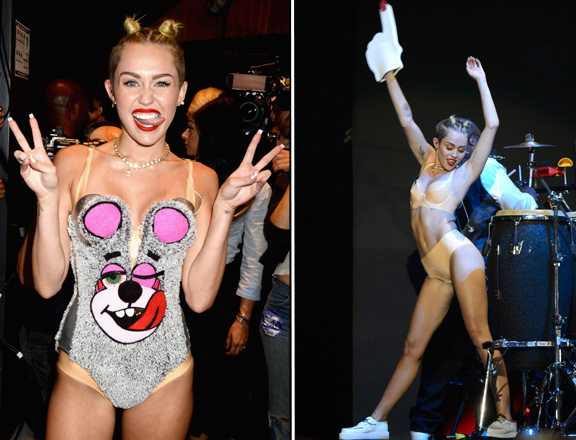
Or, Why The Whole VMA Incident Is a Really Teachable Anthropological Moment
My older daughter (and probably my students) will confirm I’m too old for this stuff … The MTV VMA show isn’t on my entertainment radar screen. Certainly not before it happens. So this year, all I kept hearing after the VMAs aired was how Miley Cyrus’s performance was way way too ___________. (Fill in your choice of extreme negative description. In general, the focus was on tasteless, but that was by far the mildest characterization.)
From the breathless-sounding media tags and omnipresent OMG vibes, I felt compelled to check it out.
OK. Especially since this VMA incident seems to have striking staying power, there’s something about what she did–and what we’ve seen–that’s compelling and compounding the ubiquitious media discourse about it. Some serious symbolically structured cultural production going on. A bit of agency, some hegemonic structures, domination, resistance, all in ritualized and ritualizing context, nonetheless somehow reproducing dominant structures and leaving us grasping for sensible glosses about why it gets to us and why it turned out the way it did.
So there’s definitely something anthropological to consider. And perhaps against my better judgment, I’d suggest that it’s actually worth the consideration, if only because the Miley Cyrus/VMA incident has really taken us ritually to some kind of disturbing threshold, creating awareness of something–or several somethings–that we now need to talk through.
It is encouraging that the 50-year celebration of the 1963 March on Washington has unmistakably gotten the message out–that crime, violence, illegal immigration, and squalid poverty in the United States are not only all too prevalent, but are systemically tied to growing income inequality, which is driven in large part by a dominant ideology that having money genuinely launders how you earned that money, as long as the sovereign legislative, executive, and judicial apparatuses (the political leanings of which may well have been influenced by some of your money, however earned, that you have used to amplify your free speech, in the form of political advertising and other political mass communication forms, such as “robo-calling”) have given you the stamp of approval that your money was earned legally, no matter how exploitative or otherwise unethically you acted.
What is not so encouraging is this. The 50-year celebration of the 1963 March on Washington has not gotten a critical corollary message out–that this ideology of wealth encourages and even celebrates unlimited private comfort, consumption, and continuous entertainment, diverting our attention from simultaneously seeing both sides of contemporary American conservatism. It is a conservative position that possessing legally sanctioned monetary wealth is itself proof of proper morality and personal responsibility. But the other side of this conservative political ideology is that there is a moral inverse: the poor are irresponsible and immoral because they tend to be parasitic violent criminals, illegal immigrants, those who fraudulently receive welfare benefits or perhaps fraudulently vote, or some combination of these.
Ritual is not the only domain of social practice that is defined by its symbolic markedness in connection to unmarked, everyday routine. Indeed, mundane patterns of social interaction, socially influenced routine behaviors, and daily intentional strategic social actions and decisions may be considered the equilibrium zone of human activity. This equilibrium zone is continuously, dynamically set and reset through symbolically structured and structuring practices that may occur across multiple social, geographic, and temporal scales. The equilibrium “routine” zone is symbolically set and reset, sometimes even over short time scales and through small social networks (or subnetworks). The symbolic boundaries of the unmarked routine at the present time would be set for the network participants by earlier structured, intentional excursions from the socially interconnected, everyday routines. The earlier instances of “excursive practices” would consist of intentional departures from the routine that produced an awareness–for individuals or through social interaction networks–that the excursion had evoked a sense of boundary between routine and the non-routine. It should be clear that ritualization is a social process that symbolically sets or resets the boundaries of routine. But play–including genuine free, creative childhood play, highly structured competitve games, improvisational performance following loosely structured rules, and even arguably musical performance and much artistic production–constitutes a complex domain of social practice that structures our awareness and the symbolic setting of homeostatic normative routine zones.
Ritual, myth, play, and associated material environments and artifacts dynamically shape paths for intentional departures from everyday routine–the mundane and profane. Interaction among ritual, myth, play, and the material environment further define the sacred as the ultimate departure from the everyday. Return to the profane will tend to be accompanied by a sense of renewal, cleansing, or perhaps social change and agency.
Emma Nilsson’s (2010) thought-provoking doctoral dissertation in architecture explores how play can thoroughly structure not only a sense of the normal or routine, but also a sense of social identity in contrast to the normal. As she argues, this is the case when ubigaming transforms–and its participants then are transformed by–the “city as a field of play.” Nilsson points out that “[p]lay has a double-relationship to rules. On the one hand, freedom to choose is a condition for the game to occur and continue; as soon as conditions are placed on it, it is no longer a game. On the other hand, the game is dependent on rule-making: the game must be irrational but not occur in the absence of logic” (2010:36; my translation). Play first and foremost makes us aware of the excursion from routine by confronting us with the continuous challenge of its ambiguity: it may be markedly orderly and disorderly, predictable and unpredictable, unsurprising and thoroughly surprising at the same time. If we want to play, we have to fully embrace this ambiguity.
Ritual and myth are often discussed in the same breath in introductory cultural anthropology textbooks (e.g., Rosman et al. 2009). Indeed, it is striking how–in so many cultural traditions–myths evoke or claim to explain the existence of certain rituals. Or how myths and rituals alike share sets of interrelated symbols, narrative arcs that challenge our everyday sense of time and geography, a general feature of symbolic richness, or emotional intensity. What is it that ritual and myth really share? And even when they don’t share formal similarities, why do they seem to be systemically interlinked in the process of culture, ultimately influencing how we think and act?
The terms "sacred" and "profane" were introduced by Henri Hubert and Marcel Mauss (English , in order to model the part-to-whole relationship between everyday social interaction and roles, on the one hand, and the dramatic religious experience of ritual sacrifice, on the other. They argued that human societies are constituted by the relationship between profane:everyday and sacred:ritual sacrifice. They argued that society gains its cohesion--amid complex, often conflicting social relationships and obligations--by its constituent individuals working together on appropriately maintaining the profane-sacred boundary. More specifically, they emphasize that the practice of ritual sacrifice allows beneficiaries or sponsors of the sacrifice to reach the sacred, transforming and conditioning them as inextricably part of society, rather than apart individuals. Anthropologists now criticize the Mauss-Hubert model for being too static and simple--"totalizing" or homogenizing the impact of ritual across the community of participants--failing to allow for individual or factional experience and agency (see Kapferer 1997:188). Yet, the Mauss-Hubert model remains a useful point of departure for understanding ritual. The reason that ritual is so effective--indeed, what makes ritual ritual--is the dramatic, participatory staging of the journey from the everyday to the threshold of the sacred (or extreme) and back.
Anthropology and Sociology–two disciplinary identities with intellectual roots that became intertwined in the 19th century and have remained so ever since–have a fundamental interest in figuring out how social groups can have regular, structured, predictable, comparable features … and yet be composed of individuals with complex, all-too-often conflicting interests. What is the relationship between the individual and the group?
Part of the interconnection between Anthropology and Sociology has involved thinking about ritual. How can ritual–something we recognize in all human societies, however constituted and identified–explain why individuals subsume their own personal interests within those of the larger group? In this post I review and clarify some key ideas and developments in the study of ritual, in order to explain why ritual emerged in human biocultural evolution as an especially important component in diverse extant cultural systems.
Ritual exerts a critical non-nested hierarchical filtering function on the individuals, cliques, and factions that constitute the cultural system of which a set of ritual practices is part. More simply, ritual is not a static part of culture and can be influenced by individual or factional agency, BUT … and this is an important “but” … ritual is particularly effective at durably guiding and constraining how individuals think and act and feel. So … how does ritual have this effect on us? What is ritual, really? How could ANYTHING we do come back to influence our sense of identity and our patterns of decision-making, our habits and bodily techniques?
First things first. Some background. Much of the early work on ritual came from French Sociology and Ethnology in the late 19th and early 20th centuries. Four works continue to have substantial influence on how anthropologists and sociologists explain ritual and religion in human social life. Henri Hubert and Marcel Mauss’s work on sacrifice (1964 [1898]), Émile Durkheim and Marcel Mauss’s work on so-called primitive classification (2009 [1903]), Arthur van Gennep’s classic synthesis of rite-of-passage or life-crisis rituals (2011 [1908]), and Durkheim’s highly influential, comprehensive work Elementary Forms of the Religious Life (1995 [1913]). The main enduring insight from Hubert, Mauss, and Durkheim’s work is that ritual makes concrete key communal concepts about how society itself is subsumed by a larger sacred or sphere. This concretization of the sacred–otherwise only an abstract notion–provides a way for different members of the group to focus and experience a shared, dramatized, specific form of the supra-societal and supernatural. Ritual recreates a sense of the individual as inextricably part of society, which is in turn inextricably part of a cosmological order.



 The Biocultural Evolution Blog